
The function of a lifting strap is beautifully simple: It eliminates your grip as the limiting factor.
In nearly every pulling exercise, your target muscle – whether it’s the lats (in rows), the traps (in shrugs), or the hamstrings/glutes (in deadlifts) – is significantly stronger than your hands and forearms.
When you reach failure on a set of heavy deadlifts, it is almost never because your glutes are fatigued; it is because your hands are opening up. Lifting straps create a non-slip, secure connection, ensuring the big, powerful muscles get fully stimulated, maximizing hypertrophy (muscle growth) and maximal strength development.
I remember when my deadlift plateaued at 365 lbs for a triple. Every time I went heavier, the bar would slide out of my right hand just past the knees. I spent six months doing grip work (like passive hangs), which helped, but my back and hamstrings weren’t growing because I couldn’t overload them. Then I added straps. Suddenly, I could pull 405 lbs for sets of 5 because I could finally focus on the lift rather than the grip. Within four months, my back thickness exploded, and because I was handling heavier loads, my actual raw grip strength also improved. Straps didn’t make me weak – they let me train heavy enough to make me truly strong
Lifting Straps Quick Guide
- What they are: A rugged fabric loop that secures your hand to the barbell.
- What they do: They eliminate your grip as the limiting factor during pulling movements.
- Why use them: To overload the target muscle (lats, hamstrings) without your hands failing first.
- The Goal: Use them to build muscle and maximal strength, while building raw grip strength separately.
What Are Lifting Straps? Understanding the Pulling Aid
Lifting straps (also known as standard loop straps or lasso straps) are simple, rugged strips of material – usually heavy-duty cotton, nylon, or sometimes leather—that measure about 1.5 to 2 inches wide.
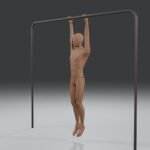
Unlike a passive hang which builds grip endurance, or wrist wraps which provide pushing stability, lifting straps are strictly for pulling. They tie your wrist directly to the barbell, dumbbell, or machine handle.
This mechanical link means you no longer have to exert all your mental and physical energy on simply holding the weight. Instead, you can focus 100% on driving with the intended muscle.
How To Use Lifting Straps (The Correct Way)
Putting straps on is simple, but often butchered in the gym. If you do it wrong, the bar will still slide.
- Thread the Loop: Thread the end of the strap through the loop to create a lasso, making sure the pad (if it has one) will sit comfortably on the back of your wrist.
- Slide the Wrist In: The loose end of the strap should lie in the same direction as your thumb. (Remember the rule: Straps follow the thumb).
- The Overhand Wrap: Lay your palm flat over the bar. Take the loose end of the strap and wrap it under the bar and around it once (sometimes 1.5 times, but once is usually enough).
- Lock and Tighten: Grip the bar over the top of the wrapped strap. Rotate your hand backward to tighten the slack. Your hand should now be ‘cinched’ to the bar with an iron grip.
Types of Straps: Material Matters for authoritative Training
As an authoritative guide, we must highlight the differences in materials. Don’t just buy the cheapest pair; choose based on your training style.
| Strap Type | Material | Pros | Cons | Ideal For |
| Cotton | Rugged Fabric | Softest on wrists; easy to “break-in.” Absorbs sweat. Very affordable (~$15). | Less stiff, can fray over time. | General Hypertrophy, High-Rep Accessory Work. |
| Nylon | Slick Synthetic | Virtually unbreakable. Stiffer than cotton. Smooth texture allows for a super-tight cinch. | Slick when sweaty. Can be harsh on the skin (abrasive). | Powerlifting, Heavy Deadlifts, Rack Pulls. |
| Leather | Cured Hide | The most durable (lifelong). Conforms to the shape of your hand. Provides a very “natural” grip feel. | The most expensive ($30+). Requires a long break-in period. Very stiff initially. | Advanced Lifters, Strongman Training. |
The “Figure-8” Trap for Advanced Use
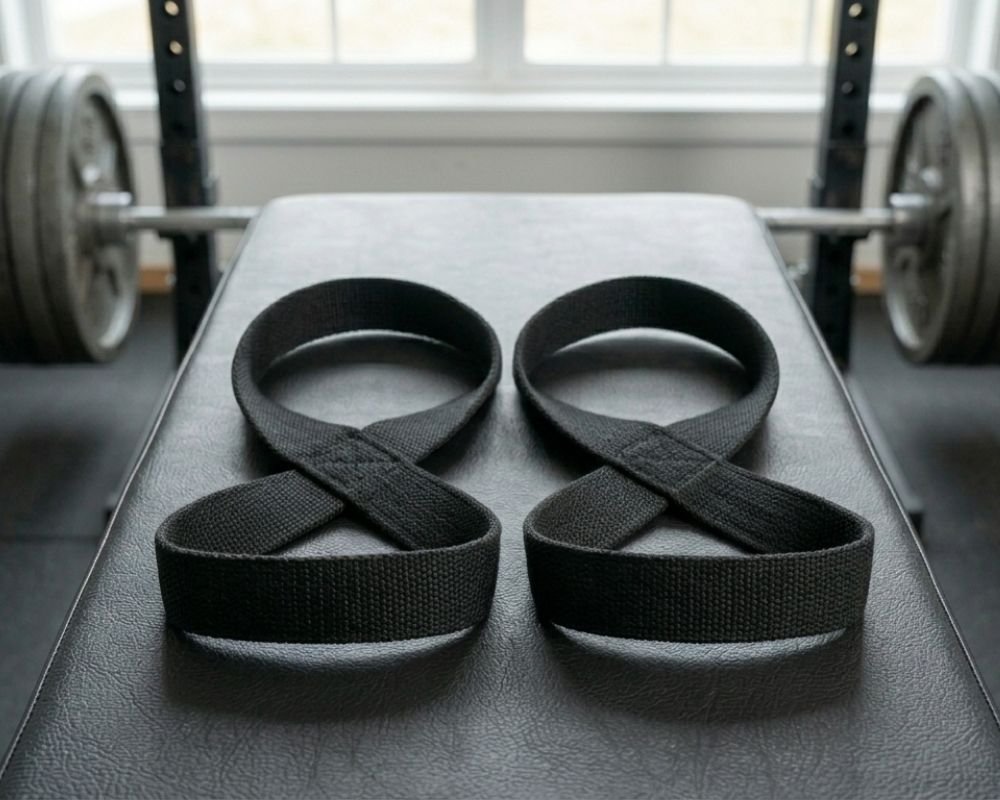
Advanced powerlifters and Strongmen use a variation called Figure-8 Straps. These require zero wrapping and look like two closed loops. They offer the absolute most secure hold possible and are mandatory for the heaviest deadlifts on earth.
When You SHOULD NOT Use Lifting Straps (Trustworthy Advice)
This is the part of the guide that builds trustworthiness. If you use them constantly, you are inviting a weak grip.
- Warm-Ups: Never use straps on any set under 80% of your maximum weight. Use raw grip to build raw strength.
- Grip-Focused Work: If your specific goal is to build forearm size or a crushed grip (like for front levers), obviously, do not use straps.
- Olympic Lifting: In the Snatch or Clean & Jerk, straps are only used during variation work (like Power Snatch from blocks). Never use straps for a full Clean, as it inhibits your ability to quickly rotate your elbows during the catch.
Summary
Lifting straps are not a ‘cheat’; they are a mandatory tool for advanced muscular and maximal strength development. They solve the functional weakness of human grip strength.
Use them with integrity: save them for your absolute heaviest top-sets of deadlifts, your heavy Romanian Deadlifts (RDLs), and your final heavy set of dumbbell or barbell rows. spend the rest of your training session building that raw forearm power that will help you in every other aspect of your physical performance.