
If planks hurt your lower back, you’re not alone. Most beginners think planks are a simple core exercise—but small mistakes can turn them into a back strain instead of a strength builder.
The good news: once you fix your form, planks become one of the safest and most effective exercises you can do at home.
This guide shows you exactly how to plank correctly, how to avoid lower back pain, and how to build real core strength step by step.
Who this is for
This guide is for:
- Beginners training at home
- Anyone who feels planks in their lower back instead of their core
- People who want to build core strength safely
Quick answer: How do you plank correctly?
To plank correctly, keep your body in a straight line, tighten your core, and make sure your lower back does not sag. Your core—not your lower back—should be doing the work.
Why your plank is causing lower back pain
1. Your hips are dropping
This is the most common problem.
When your hips drop, your lower back takes over the load.
👉 Fix: Slightly tuck your hips and squeeze your glutes.
2. Your core isn’t engaged
If your abs aren’t tight, your spine isn’t supported.
👉 Fix: Brace your core like you’re about to be pushed.
3. You’re holding too long
Long planks with bad form do more harm than good.
👉 Fix: Shorten your hold and focus on quality.
4. You’re not strong enough yet (and that’s okay)
Planks require more strength than most beginners expect.
👉 Fix: Start with easier variations and different ab/core exercises like regular sit ups or hanging leg raises.
How to plank correctly (step-by-step)
Step 1: Set up your position
- Elbows under shoulders
- Forearms on the ground
- Feet hip-width apart
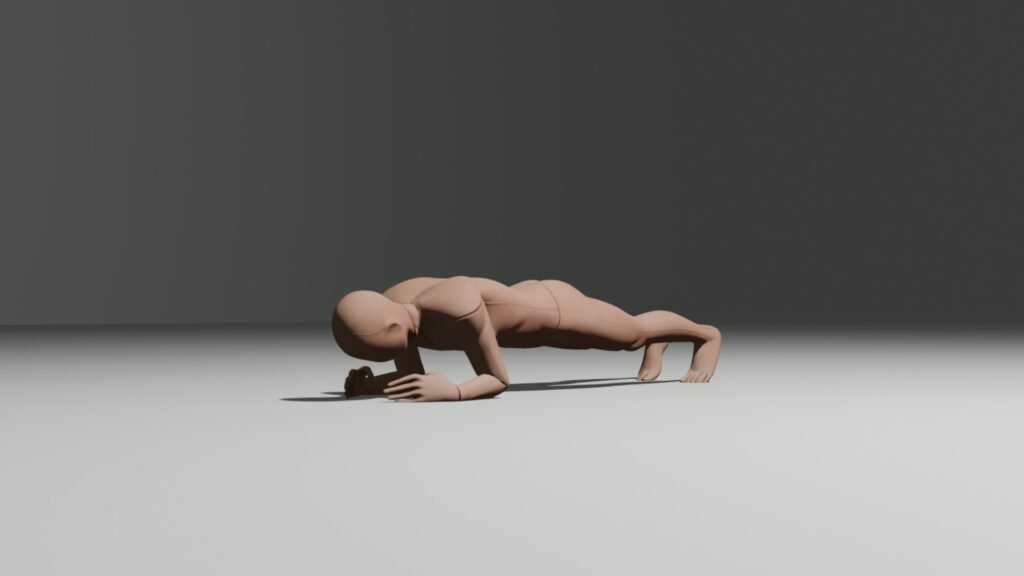
Step 2: Create a straight line
- Head, shoulders, hips, and heels aligned
- Don’t let hips drop or rise too high
Step 3: Brace your core
- Tighten your abs
- Squeeze your glutes
- Slightly tuck your pelvis
Step 4: Hold with control
- Breathe normally
- Stay tight
- Stop before form breaks
If you only focus on one thing
👉 Keep your core tight and your hips from dropping.
This alone fixes most plank problems.
Beginner plank progressions (start here)
Level 1: Incline plank
- Hands on a bench or table
- 20–40 seconds
Level 2: Knee plank
- Knees on the ground
- Focus on core tension
- 20–30 seconds
Level 3: Standard plank
- Full plank position
- 20–45 seconds
Level 4: Advanced plank
- Longer holds
- Add shoulder taps or leg lifts
- Add weight plates on your back or use weighted vest
How long should you hold a plank?
Start with:
- 15–20 seconds
Build up to:
- 30–45 seconds
You don’t need long holds. Short, strong planks are more effective.
Common plank mistakes
Why does your lower back hurt during planks?
Because your hips are dropping and your core isn’t engaged.
Why do you feel planks in your shoulders?
Your core isn’t doing enough work, so your shoulders compensate.
Why can’t you hold a plank long?
You’re likely going too advanced too soon.
How to add planks to your routine
Use planks 2–3 times per week:
- 3 sets per workout
- Rest 30–60 seconds
You can include them in a simple routine like this:
👉 Beginner Bodyweight Workout Plan (No Equipment Needed)
If you’re just starting, begin with the full system here:
👉 Beginner Bodyweight Training Guide (No Equipment Needed)
Plank vs hollow body hold (which is better?)
Both are effective:
- Planks → easier to learn, great for beginners
- Hollow body hold → more intense, full-body tension but personally I feel like hollow body holds are less technical than planks and thus “easier. I would recommend to try them out also.
👉 Ideally, use both in your training.
How long until your plank improves?
With consistent practice:
- 1–2 weeks: better control
- 3–4 weeks: longer holds
- 6+ weeks: strong, stable core
FAQ
How often should beginners do planks?
2–3 times per week is enough to build strength.
Are planks safe for your back?
Yes—if done correctly. Poor form is what causes pain.
Is a longer plank better?
No. Quality matters more than duration.
Final advice
Planks are simple, but not easy. Focus on control, not time.
If your lower back hurts, it’s a form issue—not a sign that planks are bad.
Fix your technique, stay consistent, and your core strength will improve quickly.