
Lunges are a practical way to build stronger legs without relying on heavy weights or complicated equipment. They train your quads and glutes while challenging your balance and control, one leg at a time.
They’re also a useful addition to calisthenics training, particularly when regular bodyweight squats no longer feel challenging enough.
I started doing lunges while working toward pistol squats. At the time, I couldn’t perform a proper pistol squat, and regular squats were my main bodyweight leg exercise. Adding lunges gave me another way to challenge my legs and develop the single-leg strength I was missing.
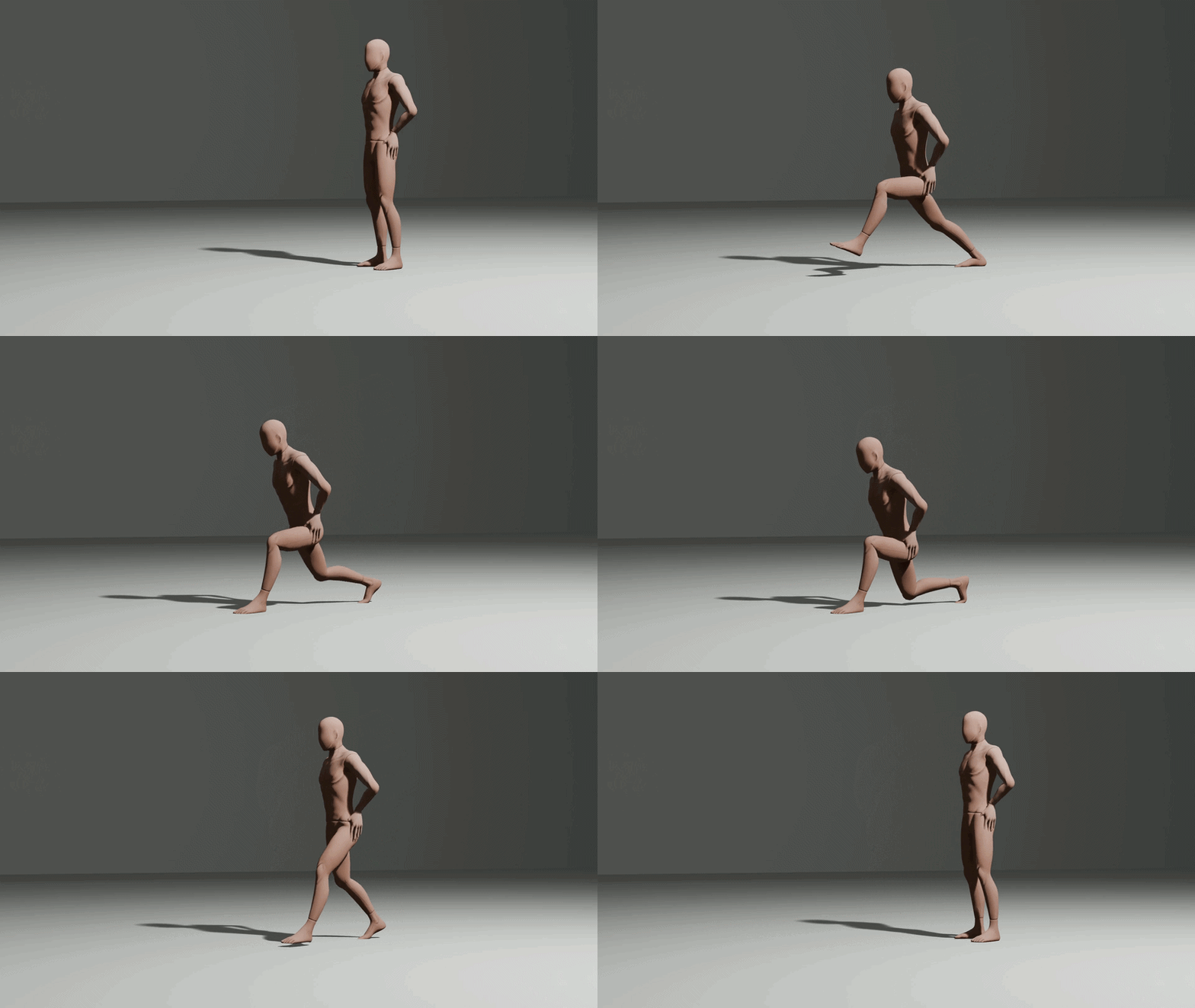
Quick answer: To perform a forward lunge, stand tall, step forward into a comfortable split stance, and bend both knees to lower your body. Keep your front foot planted, control your balance, then push through your front leg to return to standing.
You can make lunges easier with a stable support or progress toward harder variations using dumbbells, kettlebells, and more demanding single-leg exercises.
Quick Lunge Form Check
Use these cues when practicing lunges:
- Feet: Start around hip-width apart and step forward without placing your feet on one narrow line.
- Step length: Choose a distance that allows both knees to bend comfortably.
- Front foot: Keep your heel and forefoot firmly planted.
- Knees: Let your front knee follow the general direction of your toes.
- Torso: Keep your core engaged and your body controlled. A slight forward lean is normal.
- Depth: Lower your back knee toward the floor without dropping onto it.
- Return: Push through your front foot to stand back up.
Most useful tip: If you struggle with balance, don’t immediately assume your legs aren’t strong enough. Try positioning your feet slightly farther apart from side to side.
Common Lunge Problems: What to Try
| Your problem | Practical solution |
|---|---|
| Losing balance | Widen your stance slightly or hold a stable support |
| Front heel lifting | Adjust your step length and keep your whole foot planted |
| Knee moving inward | Slow down and keep the knee tracking with your toes |
| Back knee hitting the floor | Reduce your depth and control the descent |
| Stride feels awkward | Experiment with a slightly shorter or longer step |
| Bodyweight lunges feel too easy | Try pauses, controlled reps, or added resistance |
| One leg feels weaker | Practice each side separately at a manageable difficulty |
| Not progressing toward pistol squats | Add specific supported single-leg squat practice |
Table of Contents
How to Do Forward Lunges With Proper Form
Forward lunges involve stepping forward, lowering into a split stance, then returning to the starting position.
They may look simple, but the stepping motion adds a balance challenge that regular squats don’t have.
Step 1: Start With a Stable Standing Position
Stand tall with your feet approximately hip-width apart.
Keep your shoulders relaxed and your core lightly braced.
You can place your hands on your hips or let your arms move naturally to help maintain balance.
Choose a flat surface with enough room to step forward safely.
Step 2: Take a Comfortable Step Forward
Step forward with one foot, maintaining some side-to-side distance between your feet.
Avoid placing your feet directly in front of each other, as though you’re walking along a tightrope.
Your step should be long enough that both knees can bend without the position feeling cramped.
There’s no single ideal stride length for everyone. Your height, leg proportions, and mobility affect what feels natural.
Step 3: Lower Your Body Under Control
Bend both knees as you lower.
Your back knee should travel toward the floor, while your front foot stays planted.
Keep your front knee moving in roughly the same direction as your toes.
Your torso can lean forward slightly, but avoid collapsing at the waist or losing control of your lower back.
Lower until you reach a comfortable depth. Both knees may approach 90 degrees, but you don’t need to force an exact angle.
Step 4: Push Back to Standing
Push through your front foot to lift your body.
Keep pressure distributed across the foot rather than rising onto your toes.
For a standard forward lunge, use the front leg to help push yourself back toward the original standing position.
Move smoothly rather than bouncing out of the bottom.
Step 5: Repeat on Both Legs
Perform the same movement with the opposite leg.
You can alternate legs or complete your repetitions on one side before switching.
Either approach works.
Focus on making both sides consistent before increasing the difficulty.
What Muscles Do Lunges Work?
Lunges challenge several major lower-body muscles while requiring your body to stabilize itself during each repetition.
| Muscle | Main role |
|---|---|
| Quadriceps | Straighten the knee as you stand |
| Gluteus maximus | Helps extend the hip and raise your body |
| Adductors | Assist hip movement and stabilization |
| Hamstrings | Assist and stabilize during the movement |
| Gluteus medius and other hip stabilizers | Help control your pelvis and leg alignment |
| Calves | Contribute to ankle and lower-leg stability |
| Core muscles | Help maintain torso control and balance |
Quadriceps
Your quadriceps contribute substantially to straightening your front knee as you return to standing.
Lunges can provide a demanding quad workout, especially when you perform challenging sets with consistent depth.
Glutes
Your glutes help extend your hips as you stand.
Depending on your stride length and body position, the movement can place different demands on your hips and knees.
You don’t need to exaggerate your stride or lean excessively forward to make lunges effective.
Balance and Stabilizing Muscles
Because your weight isn’t distributed evenly between two parallel feet, your body must control movement from side to side.
That makes lunges useful for practicing stability and coordinating your lower-body muscles.
However, they’re not a replacement for every other form of balance or single-leg training.
How to Make Lunges Easier
If regular forward lunges feel difficult, start by simplifying the movement.
You don’t need to perform deep repetitions immediately.
Supported Lunges
Hold a stable railing, exercise rack, or countertop while stepping into your lunge.
Use just enough support to maintain balance.
This allows you to concentrate on controlling the lowering and pressing movements rather than worrying about falling.
Gradually reduce the assistance as you become more confident.
Stationary Split Squats
A split squat uses a similar body position, but your feet stay in place throughout the repetitions.
Step into a comfortable staggered stance, then lower and raise your body without repeatedly stepping forward.
This removes the additional balance challenge of moving your feet during every repetition.
It’s a useful starting point if forward lunges feel unstable.
Reverse Lunges
Reverse lunges involve stepping backward instead of forward.
Some people find them easier to control because their working front foot stays planted throughout the movement.
They’re worth trying if forward lunges feel awkward.
Lunge Variations: Beginner to Advanced
There are several ways to adjust lunges depending on your current strength and training goals.
| Variation | Main difference | When to try it |
|---|---|---|
| Supported Lunge | Uses assistance for balance | You’re learning the movement |
| Stationary Split Squat | Feet remain in position | Stepping lunges feel unstable |
| Reverse Lunge | Step backward | You prefer a controlled stepping movement |
| Forward Lunge | Step forward and return | General leg strength and balance |
| Walking Lunge | Continue moving forward | You want continuous repetitions |
| Paused Lunge | Brief pause at the bottom | You want more control and difficulty |
| Dumbbell or Kettlebell Lunge | Adds external resistance | Bodyweight repetitions become manageable |
| Bulgarian Split Squat | Rear foot elevated | You want a harder single-leg-focused exercise |
| Jumping Lunge | Adds an explosive jump | You have the strength and control for plyometric training |
These variations don’t form one mandatory progression ladder.
Choose the movement that addresses your current goal.
Forward vs. Reverse Lunges
Both are useful lower-body exercises.
Forward lunges require you to step out, absorb your movement, then push back.
Reverse lunges involve stepping backward and returning to standing, with the front foot remaining planted.
Neither is universally better.
If one feels noticeably more comfortable and controlled, there’s no reason you must use the other.
Walking Lunges
Instead of returning to your original position after every repetition, step forward with the next leg.
This creates a continuous walking movement.
Walking lunges are useful when you have enough room to move and want to challenge your legs while maintaining balance between steps.
Keep your stride consistent and avoid rushing.
Paused Lunges
Lower into your normal lunge position and pause briefly near the bottom.
Maintain tension rather than relaxing onto your back knee.
Then return to standing.
A short pause can make familiar bodyweight repetitions more demanding without adding equipment.
Bulgarian Split Squats
Bulgarian split squats involve placing your rear foot on an elevated surface.
This changes the leverage and can increase the difficulty for your working leg.
Start with a low, stable support and build control before increasing the challenge.
It’s a useful option once regular lunges and split squats have become comfortable.
My Experience: Using Lunges to Progress Toward Pistol Squats
I originally started exploring bodyweight leg exercises because I wanted to learn pistol squats.
However, I quickly discovered that performing a proper pistol squat was much harder than I expected.
So I started with regular bodyweight squats.
Those were useful, but I wanted another lower-body exercise that would challenge my legs differently.
That’s when I began including lunges.
Why I Added Lunges to My Training
Regular squats train both legs together.
Lunges challenged me to work more through one leg at a time while controlling my balance.
I found that combination useful while working toward more demanding single-leg exercises.
Sometimes I performed lunges before squats. Other times I used them afterward, depending on the session.
Adding them gave my lower-body workouts more variety and, in my experience, helped me develop strength relevant to my pistol-squat goal.
How Many Lunges Do I Usually Do?
I generally aim for approximately 8–10 repetitions per leg.
That’s enough to make my legs work and produce a noticeable muscular pump, particularly when I combine lunges with squats.
Of course, feeling a pump doesn’t automatically mean an exercise is producing more muscle growth.
What matters is that the repetitions provide an appropriate challenge and become progressively more demanding as your strength improves.
My advice: If you’re doing only regular bodyweight squats and want to progress toward harder single-leg exercises, lunges are worth including.
You don’t need weights to begin.
Do Lunges Help You Learn Pistol Squats?
Yes, lunges can help develop some of the strength, coordination, and balance needed for pistol squats.
But they aren’t a complete pistol-squat progression by themselves.
A pistol squat requires you to lower and raise your body primarily using one leg, while the other leg remains unsupported in front of you.
That introduces additional demands on:
- Single-leg strength.
- Balance and coordination.
- Ankle and hip mobility.
- Control at the bottom of the squat.
- Maintaining the non-working leg in front.
Lunges are useful because they introduce asymmetrical lower-body loading while keeping both feet available for support.
A Practical Path Toward Pistol Squats
| Stage | Exercise | Main goal |
|---|---|---|
| 1 | Bodyweight Squats | Develop basic squat strength and control |
| 2 | Lunges and Split Squats | Challenge each leg more independently |
| 3 | Bulgarian Split Squats | Increase the demand on the working leg |
| 4 | Supported Single-Leg Squats | Practice the specific movement with assistance |
| 5 | Controlled Single-Leg Squats to a Box | Develop strength through a manageable depth |
| 6 | Pistol Squat Progressions | Gradually work toward the full movement |
This isn’t a fixed set of tests you must pass.
You can practice assisted pistol-squat movements while continuing to train lunges and regular squats.
If pistol squats are your goal, prioritize the skill-specific progression alongside general leg-strength exercises.
For the basic squat movement, see our How to Do Bodyweight Squats Guide.
Lunges vs. Squats: Do You Need Both?
Squats and lunges train many of the same lower-body muscles, but the movements differ in meaningful ways.
| Feature | Bodyweight Squats | Lunges |
|---|---|---|
| Foot position | Both feet alongside each other | Split stance |
| Loading | More evenly shared between legs | Greater emphasis on the working leg |
| Balance demands | Generally easier to manage | More demanding for many beginners |
| Progression options | Depth, tempo, pauses, added load | Stride, assistance, variations, added load |
| Useful for | General lower-body strength | Leg strength with additional unilateral demands |
Should You Do Lunges Before or After Squats?
It depends on your goal.
If squats are your main strength exercise, perform them first while you’re fresh.
You can then use lunges as an additional lower-body exercise.
If you’re particularly interested in improving lunges, performing them earlier may allow better concentration and stronger sets.
I’ve used both approaches.
Neither is inherently wrong, provided you’re managing your total workout difficulty and maintaining good technique.
Beginner Lunge Workout
You don’t need a separate workout dedicated entirely to lunges.
They work well in a regular lower-body or full-body training routine.
For many beginners, two sessions per week is a reasonable starting point, with recovery between demanding leg workouts.
Workout A: Learning Lunges
| Exercise | Sets and reps |
|---|---|
| Supported Lunges or Split Squats | 2 × 6–8 per leg |
| Bodyweight Squats | 2 × 8–12 |
| Optional Single-Leg Balance Practice | 2 short holds per side |
Begin with a comfortable depth and use assistance as needed.
Your priority is controlling each repetition rather than reaching a particular number.
Workout B: Building Bodyweight Leg Strength
| Exercise | Sets and reps |
|---|---|
| Bodyweight Squats | 3 × 10–15 |
| Forward or Reverse Lunges | 3 × 8–10 per leg |
Rest approximately 1–2 minutes between sets, or longer if necessary.
This is close to how I began combining lunges with squats during my own training.
If the session becomes too demanding, reduce the number of sets rather than letting your technique deteriorate.
Workout C: Progressing Toward Single-Leg Strength
| Exercise | Sets and reps |
|---|---|
| Supported Single-Leg Squat Practice | 2 × 3–6 per side |
| Lunges or Bulgarian Split Squats | 3 × 6–10 per leg |
| Bodyweight Squats, optional | 2 × 10–15 |
Choose versions you can control.
This approach combines strength development with practice that more closely resembles your long-term single-leg goal.
You don’t need to use all three example workouts in the same week.
For a full-body routine, see our Beginner Bodyweight Program.
How to Make Lunges Harder
Once you can comfortably perform your current lunge variation, you have several ways to progress.
1. Increase Your Repetitions
For example, you might gradually improve from 3 sets of 8 repetitions per leg to 3 sets of 10.
Make sure your balance and range of motion remain consistent.
2. Add a Brief Pause
Pause near the bottom of each repetition before standing up.
This removes some of the temptation to rush and makes you control the position.
3. Try a Harder Variation
Walking lunges, Bulgarian split squats, and other single-leg variations can increase the challenge without needing additional weight.
4. Add Dumbbells or a Kettlebell
Holding external weight is a straightforward way to increase resistance.
You could hold a dumbbell in each hand or a single dumbbell or kettlebell near your chest.
Start with a manageable weight that doesn’t compromise your balance.
The movement should remain controlled, even when the added resistance becomes challenging.
Do You Need Weights for Lunges?
Not initially.
Bodyweight lunges can be difficult enough for beginners, especially when performed through a controlled range.
However, if your goal is continued leg-strength or muscle development, external resistance may eventually be useful.
If you’re already comfortable with bodyweight lunges, adjustable dumbbells can provide a convenient way to increase difficulty without learning a new exercise.
A kettlebell is another option, especially if you also want to use it for other exercises.
Check how much kettlebells are on Amazon
Choose equipment based on the weight range you actually need, grip comfort, available space, and price.
You don’t need to buy weights solely to make lunges harder. Single-leg variations can remain challenging with bodyweight alone.
Common Lunge Mistakes
1. Taking a Step That’s Too Short
A very short step can make the bottom position feel cramped.
What to try: Experiment with a slightly longer stride so both knees can bend comfortably.
You don’t need to make the step excessively long.
2. Taking an Unnecessarily Long Step
An exaggerated stride can make balance difficult and may place you in an uncomfortable position.
What to try: Shorten the step until you can lower and stand with control.
3. Placing Both Feet on One Line
Stepping as though you’re walking on a tightrope makes it harder to balance.
What to try: Keep some space between your feet from side to side.
4. Letting the Front Knee Collapse Inward
If your front knee moves inward uncontrollably, it may become difficult to maintain consistent leg alignment.
What to try: Slow the movement and let your knee track in the same general direction as your toes.
Don’t force the knee aggressively outward.
5. Dropping the Back Knee Onto the Floor
The rear knee shouldn’t be used to catch your bodyweight.
What to try: Lower slowly and stop before you lose control.
You can increase your depth gradually.
6. Adding Weight Too Soon
A heavier dumbbell or kettlebell isn’t useful if it makes your balance or technique noticeably worse.
What to try: First establish a consistent bodyweight movement, then increase resistance in manageable steps.
Should Your Knee Go Past Your Toes During Lunges?
This is a common source of confusion.
You may have heard that your front knee must never move beyond your toes.
That isn’t a universal rule.
Knee position depends on your stride length, ankle mobility, body proportions, and the variation you’re performing.
Forward knee movement isn’t automatically a technique mistake.
The more useful priorities are:
- Keeping your whole front foot supported.
- Maintaining balance.
- Allowing your knee to follow your toes.
- Using a comfortable and controlled range of motion.
- Avoiding painful or unstable positions.
If a particular stride feels uncomfortable, adjust it rather than forcing your knee to stay behind an imaginary line.
For readers with existing knee symptoms, appropriate exercise selection and loading may need individual guidance.
Frequently Asked Questions
Are Lunges Good for Beginners?
Yes, when the difficulty is appropriate.
Beginners can start with supported lunges, split squats, or reverse lunges before progressing to more demanding variations.
How Many Lunges Should I Do?
A practical starting point is 2–3 sets of approximately 6–12 repetitions per leg.
Adjust this based on your strength, balance, and total workout volume.
I personally often use around 8–10 repetitions per leg.
Are Lunges Better Than Squats?
Neither exercise is universally better.
Squats provide a straightforward way to develop bilateral leg strength, while lunges add more asymmetrical loading and balance demands.
Including both can be useful.
Do Lunges Build Muscle?
Yes. Lunges can contribute to lower-body muscle development when the exercise provides sufficient resistance and challenging training.
As you become stronger, you may need harder variations or additional weight.
Do Lunges Help With Balance?
They challenge your ability to control your body in a split stance.
With practice, you may improve at managing balance during the movement.
However, that doesn’t mean lunges alone develop every type of balance required for other skills.
Are Forward or Reverse Lunges Easier?
Some people find reverse lunges easier to control because the front foot remains planted.
Others prefer forward lunges.
Experiment with both and choose the variation you can perform comfortably.
Can I Do Lunges Every Day?
You don’t need to.
Two or three appropriately spaced leg-training sessions per week can be a practical starting point.
Training frequency should reflect your workout intensity, total volume, and recovery.
Do Lunges Help With Pistol Squats?
They can help build useful single-leg strength, balance, and coordination.
However, pistol squats also require specific mobility, balance, and control that you’ll need to practice separately.
Do I Need Dumbbells for Lunges?
No.
Start with bodyweight and increase the difficulty when necessary.
Dumbbells and kettlebells are optional ways to add resistance.
What If Lunges Hurt My Knees?
Stop forcing a painful movement.
You can experiment with a different stride, reduced depth, or an easier variation, but persistent or worsening pain deserves professional assessment.
Don’t assume every knee problem is caused by one specific technique mistake.
Final Thoughts: Lunges Are More Than an Alternative to Squats
When I started training toward pistol squats, I realized regular bodyweight squats weren’t the only exercise I could use to develop stronger legs.
Adding lunges gave me a way to challenge each leg more independently while practicing balance and control.
I still think they’re one of the most practical exercises to combine with squats, especially if you train mainly with your bodyweight.
Start with a comfortable stance, learn to control the descent, and build toward approximately 8–10 repetitions per leg if that matches your ability.
As you improve, you can increase the challenge through different variations or added resistance.
The key is to progress beyond simply collecting more repetitions. Choose a variation that challenges your current strength while allowing consistent technique.
And if pistol squats are your long-term goal, use lunges as part of your preparation—not as a replacement for practicing the specific single-leg squat movement.
For more lower-body training advice, continue with our Bodyweight Squat Guide or explore our How to Start Bodyweight Training Guide.