
Parallettes are useful for calisthenics, but you don’t need them to get strong.
A pair of these small, elevated bars can make certain exercises more comfortable, give you extra room for L-sits, and allow a deeper range of motion during push-ups and other pressing movements.
The important question isn’t whether parallettes are good equipment. It’s whether they’re useful for the exercises you actually want to train.
If you’re mostly doing regular push-ups, squats, and pull-ups, you might not need them yet. But if you’re interested in L-sits, planche progressions, handstand training, or pike push-ups, a stable pair can become a useful part of your setup.
Quick recommendation: For general floor-based calisthenics, low or moderately elevated parallettes are a practical starting point. Choose taller bars only if you specifically need additional ground clearance or plan to perform exercises that require it.
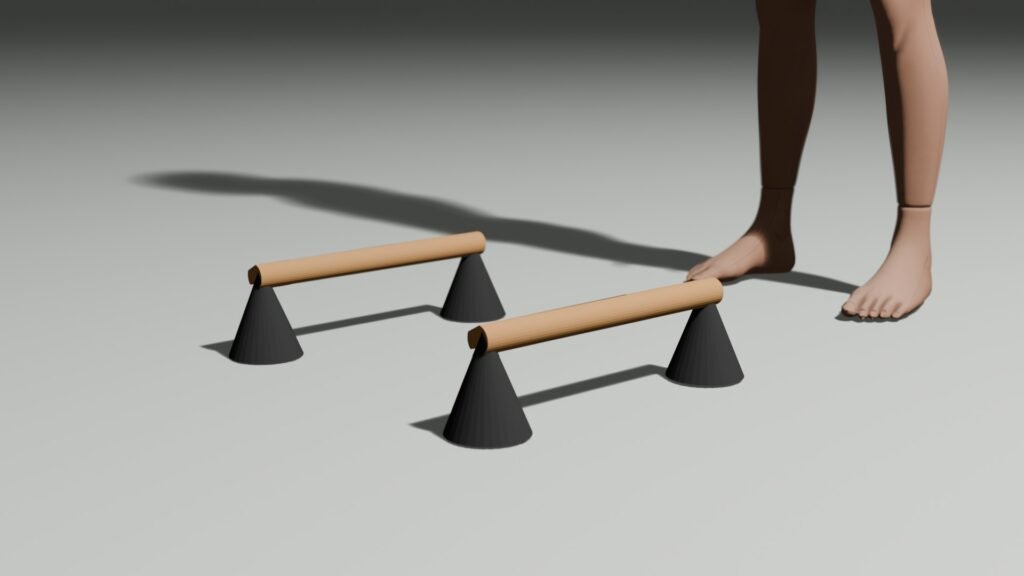
What Are Calisthenics Parallettes?
Parallettes are two short, parallel exercise bars that support your bodyweight through your hands.
They resemble miniature gymnastics parallel bars and are commonly used for:
- Push-ups and deeper push-up variations
- L-sits and tuck holds
- Planche leans and planche progressions
- Pike push-ups
- Handstands and handstand progressions
- Other bodyweight support and balance exercises
Unlike ordinary push-up handles, parallettes are often designed with longer gripping surfaces and a more stable base suitable for static bodyweight skills.
However, designs vary. Some compact parallettes are little more than sturdy push-up bars, while taller models begin to resemble freestanding dip stations.
Low vs. Medium vs. High Parallettes: Which Should You Choose?
The height matters more than many beginners realize.
A low pair and a tall pair may both be called parallettes, but they can feel quite different during the same exercise.
| Type | Best suited for | Main drawback |
|---|---|---|
| Low parallettes | Push-ups, planche leans, handstands, compact floor skills | Less clearance for your legs |
| Medium-height parallettes | L-sits, pike push-ups, deeper pressing movements | Take more space and may feel less convenient for some floor skills |
| Tall parallettes / dip stands | Suspended dips, leg raises, and supported bodyweight exercises | Bulkier and require greater stability |
These aren’t standardized equipment categories. Always check the actual dimensions rather than relying entirely on the product name.
Low Parallettes
Low parallettes keep your hands close to the floor.
They’re especially practical for planche leans, push-ups, and handstand practice because they don’t raise your body unnecessarily high.
They’re also compact, easy to store, and suitable for many common calisthenics skills.
The limitation is ground clearance.
If you’re working on an L-sit and your feet constantly touch the floor, a slightly taller pair might make learning more manageable.
Medium-Height Parallettes
These provide more room beneath your body.
That can be useful for tuck L-sits, L-sits, deficit push-ups, and pike push-ups.
If you regularly practise several different exercises on parallettes, this extra clearance may be worthwhile.
But taller doesn’t automatically mean better. A higher support position changes how the movement feels, and the stability of the equipment becomes increasingly important.
Tall Parallettes and Dip Stands
Tall bars can support exercises such as full suspended dips, provided they’re specifically designed and rated for those movements.
They’re useful if you want a compact alternative to permanently installed parallel bars.
However, I wouldn’t recommend tall bars solely for ordinary push-ups or planche leans.
They take up more room, and you may never use the additional height.
My advice: Choose the height based on the movement you intend to practise most often, not on the number of exercises advertised on the packaging.
Are Parallettes Actually Worth Buying?
For some calisthenics athletes, absolutely.
For others, they’re an unnecessary purchase.
Here’s how I’d make the decision.
| Your main goal | Would I recommend parallettes? |
|---|---|
| Learn regular push-ups | Optional — the floor or a stable incline is enough |
| Make floor pressing more comfortable for your wrists | Worth trying, but not a guaranteed solution |
| Learn L-sits | Useful for additional ground clearance |
| Practise planche leans | Useful, especially if you prefer a neutral grip |
| Improve pike push-ups | Useful for grip options and additional depth |
| Learn handstands | Optional — both floor and parallette practice have value |
| Perform full dips | Only with appropriately rated, stable bars |
| General beginner bodyweight training | Not a priority purchase |
The biggest mistake would be buying parallettes because they’re described as essential calisthenics equipment.
You can build plenty of strength without them.
Where they become valuable is when they solve a specific limitation or make an exercise more practical to train.
Do Parallettes Help With Wrist Discomfort?
This is one of the most common reasons people try them.
During a regular floor push-up, your wrists are usually extended while supporting part of your bodyweight.
Gripping parallettes allows a more neutral wrist position.
For some people, that feels considerably more comfortable.
However, that doesn’t mean parallettes eliminate wrist stress or prevent injuries. They change your hand position and how forces are transmitted through your upper body, rather than removing those forces.
You still need to develop strength and control in the movement.
My Experience With Parallettes
I’ve used parallettes occasionally for pike push-ups, particularly when experimenting with a different wrist position and a greater range of motion.
When I first started practising pike push-ups, my wrists sometimes felt uncomfortable. Using handles or parallettes gave me another hand position to work with.
I also liked having the option to lower my head farther between my hands.
That doesn’t mean the parallette version was automatically better. The increased range made the exercise more demanding, and I still needed to control how far I lowered.
I wouldn’t recommend buying parallettes as a substitute for addressing persistent wrist pain.
If your wrists regularly hurt during training, reduce the aggravating movement and investigate the cause rather than simply pushing through it with different equipment.
Can Parallettes Increase Your Range of Motion?
Yes, depending on the exercise.
During an ordinary floor push-up, the floor limits how far your chest can travel downward.
With sufficiently tall parallettes, your chest can move below the height of your hands.
This creates what is commonly called a deficit push-up.
The same idea applies to pike push-ups, where extra space can allow a deeper pressing movement.
But additional depth is only useful when you can control it.
Going deeper may increase the difficulty and place your shoulders through a greater range of motion. There’s no need to force the deepest possible repetition.
Start with the range you can comfortably manage and increase it gradually.
Best Calisthenics Exercises to Do on Parallettes
You don’t need dozens of exercises to get value from a pair.
These are the movements I’d prioritize.
1. Push-Ups and Deficit Push-Ups
Parallettes give you an alternative gripping position and, if they’re tall enough, the option to lower your chest farther.
Keep your body aligned, maintain control through your shoulders, and lower only as deeply as feels manageable.
If you can’t yet perform a standard push-up, using ordinary low parallettes doesn’t significantly reduce the exercise’s difficulty. A properly secured higher incline is generally more appropriate.
See the movement: How to Do Push-Ups — Form Guide With Animation.
2. Pike Push-Ups
Pike push-ups are one of my favorite reasons to use parallettes.
With your hips elevated and your torso angled downward, the exercise trains shoulder-focused pressing strength.
Parallettes can give you a different wrist position and enough space to increase the depth of the movement.
But don’t immediately lower your head as far as possible.
Keep the movement controlled and gradually increase the range as your strength develops.
See the movement: Pike Push-Ups — Technique, Animation & Progressions.
3. L-Sits and Tuck L-Sits
Parallettes can make L-sit practice more convenient because your hands are elevated above the floor.
That extra clearance gives you room to lift your legs without immediately touching the ground.
Start by supporting yourself with your arms extended, then bring your knees toward your chest.
As you develop control, experiment with extending one leg or both legs forward.
You can also train L-sits directly on the floor, although the limited clearance can make them more demanding.
Learn the progression: How to Do an L-Sit.
4. Planche Leans and Planche Progressions
For planche training, parallettes offer a stable gripping position while you develop the ability to lean your shoulders forward beyond your hands.
Start with your feet supported and your arms extended.
Gradually increase the forward lean while maintaining body tension and control.
You don’t need to lift your feet to make planche leans challenging.
Low, stable parallettes are often convenient for this type of practice.
See the movement: How to Do a Planche — Progression Guide With Animations.
5. Handstands
Parallettes allow you to balance on a gripping surface rather than placing your palms flat on the ground.
Some athletes prefer this wrist position, while others find balancing on the floor more natural.
Handstands on parallettes require their own balance adjustments, so don’t assume they’ll be easier simply because you can grip the handles.
Use a suitable, secure setup and progress cautiously.
For beginners, practising handstand alignment and balance close to the floor is still valuable.
Wooden vs. Metal vs. PVC Parallettes
The material affects grip feel, weight, rigidity, durability, and price.
| Material | Advantages | Things to consider |
|---|---|---|
| Wood | Comfortable natural texture, often good grip feel | Quality of construction and finish varies |
| Steel | Can be very rigid and durable | Often heavier; finish and grip texture matter |
| PVC | Can be inexpensive and lightweight | Construction quality and flex vary considerably |
Wooden Parallettes
Wooden handles are popular because they often feel pleasant to grip and provide a comfortable texture.
But I wouldn’t automatically claim wood is superior to metal.
A well-designed metal bar might be more comfortable for you than a poorly finished wooden one.
Steel Parallettes
Steel can provide a rigid, durable construction.
Some models have rubberized or textured handles, while others use painted or powder-coated metal.
Check the grip diameter, finish, and stability rather than judging the product by material alone.
PVC Parallettes
PVC models can be an affordable option, including some DIY designs.
However, the strength and stability depend heavily on the design, pipe dimensions, fittings, and construction quality.
I wouldn’t recommend an untested DIY pair for advanced balancing or dynamic movements.
Whatever the material, choose equipment that is designed to support the loads and movements you intend to perform.
What to Check Before Buying Parallettes
You don’t need the most expensive pair, but a few details matter.
Stability Comes First
The bars should sit firmly on the floor without rocking.
Look for a sufficiently broad base and suitable nonslip feet.
Test the equipment on the actual surface where you’ll train. Bars that grip well on a rubber gym floor may behave differently on polished tile or wood.
Check the Load Rating
Look for a clearly stated manufacturer load rating and any restrictions on exercise use.
Static bodyweight support and dynamic movements aren’t necessarily equivalent.
A bar rated for push-ups may not be appropriate for handstand practice or dips.
Choose a Comfortable Grip
Handle thickness affects how the bar feels in your hands.
A very thick handle may be uncomfortable for someone with smaller hands, while another athlete may prefer it.
There’s no universally ideal diameter, so compare dimensions with equipment you’ve used comfortably before.
Think About Storage
If you train at home, consider where the bars will go between sessions.
Low parallettes are generally much easier to store than tall dip stands.
Equipment that is convenient to set up is more likely to become part of your regular training.
Don’t Pay Extra for Features You Won’t Use
You probably don’t need tall, adjustable parallettes if your main exercises are planche leans and ordinary push-ups.
On the other hand, paying for very low bars may be frustrating if your main goal is practising L-sits with additional leg clearance.
Choose according to your goals rather than buying the model with the longest list of claimed benefits.
How to Grip Parallettes Correctly
Your grip should feel secure and allow you to control the movement.
For most exercises:
- Place the parallettes on a firm, level surface.
- Position them at an appropriate width for the exercise, often near shoulder width.
- Wrap your fingers comfortably around the handles.
- Keep your hands centered over the support structure where practical.
- Apply pressure evenly without letting the bars tip or slide.
A neutral grip means your palms face inward toward one another.
However, your exact hand position and the direction of the bars can vary with the exercise and your individual comfort.
For planche leans, focus on keeping your arms and shoulders controlled rather than forcing a particular wrist or elbow angle.
If you notice the bars shifting as you lean, stop and correct the setup.
Can You Build Muscle Using Parallettes?
Yes, but the equipment itself isn’t what builds muscle.
Parallettes let you perform bodyweight exercises that challenge your chest, shoulders, triceps, and other muscles.
As with other forms of strength training, progress depends on applying an appropriate challenge over time.
For example, a controlled deficit push-up may be more demanding than your regular floor push-up.
An L-sit can provide a substantial challenge for your core and hip flexors.
But you don’t have to use parallettes to develop those muscles.
They’re one way to modify exercises and expand your training options.
Do Beginners Need Parallettes?
Not necessarily.
If you’re beginning calisthenics, I’d prioritize learning the fundamentals:
- Push-ups and an appropriate progression
- Pull-ups or rowing variations
- Squats and lunges
- Basic core exercises
You can do most of that without parallettes.
Once you know which movements you enjoy and what limitations you’re encountering, you’ll be in a better position to decide whether they’re worth buying.
If your goal is eventually to learn skills such as L-sits, handstands, and the planche, a good pair might be useful for years.
But your first month of calisthenics doesn’t need to begin with an equipment shopping list.
Frequently Asked Questions
Are Parallettes Better Than Push-Up Bars?
Not necessarily.
Basic push-up bars may be perfectly adequate for ordinary push-ups.
Parallettes often provide longer handles or a more substantial base, making some models better suited to static calisthenics skills.
Compare actual construction and intended use rather than relying only on the product label.
Are Low or High Parallettes Better?
Low parallettes are convenient for floor-based skills, while higher bars offer greater clearance.
For a first pair, I’d usually prioritize low or moderately elevated bars unless your training specifically requires more height.
Do Parallettes Make Push-Ups Easier?
Not automatically.
A slightly raised hand position from low parallettes doesn’t have the same effect as using a high incline.
Parallettes may improve comfort for some people, but deeper push-ups can actually be more challenging.
Are Parallettes Good for Planche Training?
They can be very useful for practising planche leans and progressively harder holds.
However, they don’t replace the strength and technique required for a planche.
Floor-based planche training remains a valid option.
Can I Use Parallettes for Dips?
Only if the bars are appropriately high, stable, spaced, and rated for the movement.
Many small parallettes are unsuitable for full suspended dips.
Use equipment specifically designed for dips rather than assuming all parallettes can support them.
Final Recommendation: Buy for the Exercises You Actually Train
Parallettes are useful because they give you options.
They can provide a different wrist position, additional range of motion, and more ground clearance for bodyweight skills.
But those advantages only matter if they help with your actual training.
If you’re doing basic calisthenics and everything feels comfortable on the floor, you don’t need to rush into buying them.
If you’re progressing toward L-sits, planche holds, deeper pike push-ups, or handstand work, they may be a worthwhile addition.
Choose a stable pair with the right height and grip for your goals. Then use them consistently rather than collecting equipment you rarely touch.
For exercises you can practise with or without parallettes, explore our Push-Up Guide, Pike Push-Up Guide, and Planche Progression Guide, each with visual demonstrations to help you understand the movements.