
Pull-ups are one of the best bodyweight exercises for developing upper-body pulling strength. They challenge your back, arms, grip, and core while requiring very little equipment.
However, pull-ups can be difficult for beginners—even for people who already have experience lifting weights.
I experienced this myself. When I started training pull-ups, I could barely lift myself despite having spent plenty of time training my back in the gym.
Over time, resistance-band-assisted pull-ups, better technique, and a focus on quality repetitions helped me progress from almost zero pull-up strength to completing 3 sets of 8 unassisted pull-ups in approximately one year.
This guide explains proper pull-up form, how to work toward your first repetition, which variations to use, and how to build strength consistently.
Quick answer: To perform a pull-up, grab a secure overhead bar with your palms facing away, start with your arms extended, and pull yourself upward until your chin clears the bar. Lower yourself under control and repeat without using an uncontrolled swing.
You don’t need to touch your chest to the bar for a standard pull-up.
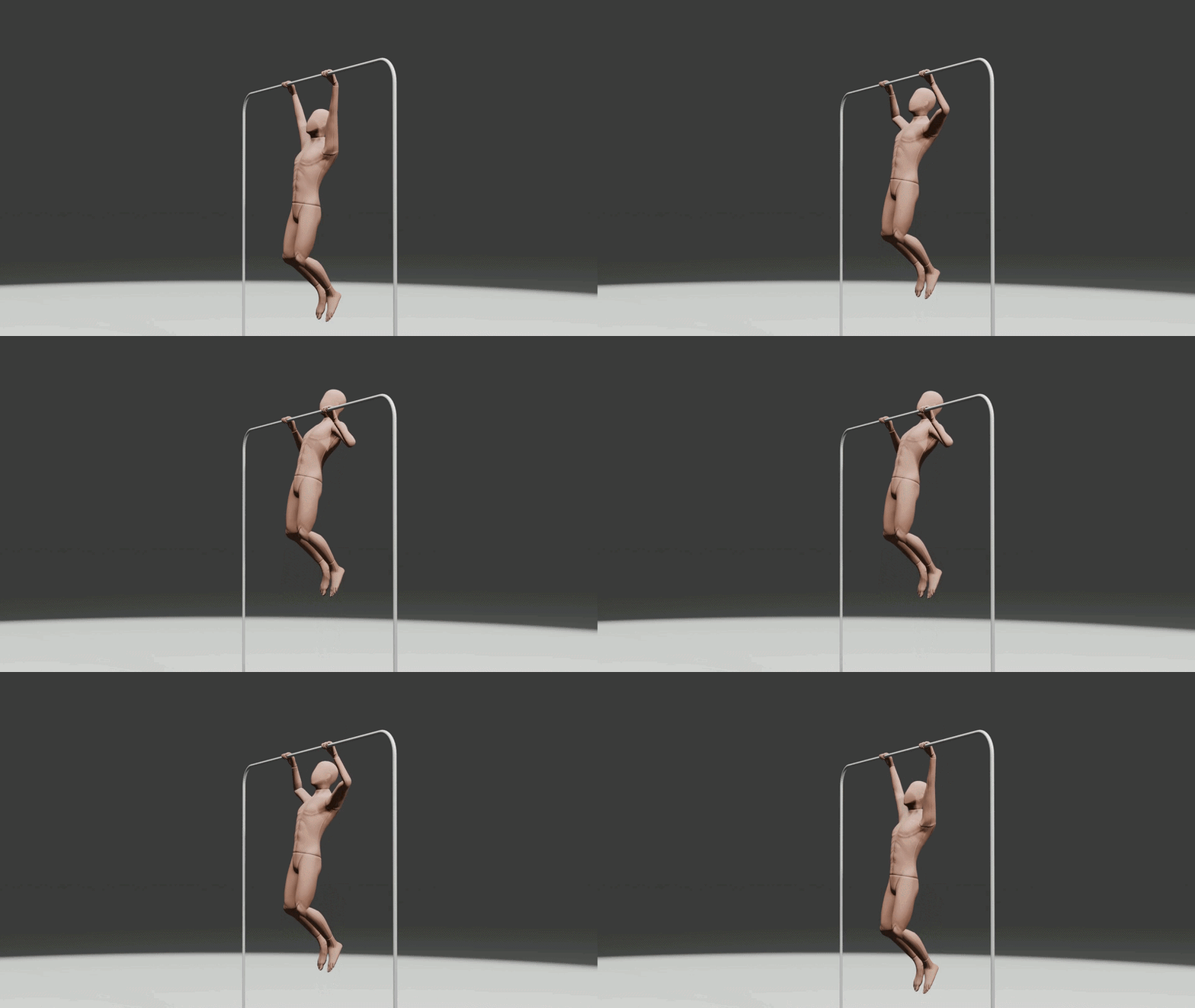
How to Do Pull-Ups With Proper Form
Follow these steps to perform a controlled pull-up.
Step 1: Grip the Bar
Use a secure pull-up bar with enough space for your body to hang freely.
Place your hands approximately shoulder-width apart or slightly wider, with your palms facing away from you.
Wrap your thumbs around the bar and make sure your grip feels secure.
You can use a stable step to reach the bar instead of jumping into position.
Step 2: Establish a Controlled Hanging Position
Begin with your arms extended and your body hanging beneath the bar.
Allow your shoulders to move into a comfortable overhead position.
Lightly engage your abdominal muscles to control your body position and reduce unnecessary swinging.
You do not need to keep your shoulders forcefully pulled down throughout the entire movement.
Step 3: Pull Your Body Upward
Begin pulling by bending your elbows and moving your upper arms toward your sides.
Think about driving your elbows downward while bringing your body toward the bar.
Your shoulder blades will move naturally throughout the exercise.
Keep your movement controlled rather than throwing your legs forward to generate momentum.
Step 4: Bring Your Chin Above the Bar
Continue pulling until your chin clears the bar.
Keep your neck in a natural position instead of stretching your chin upward to make the repetition count.
You don’t need to touch your chest to the bar.
Chest-to-bar pull-ups are a more demanding variation and can be practiced later.
Step 5: Lower Yourself Under Control
Gradually straighten your elbows and return to the starting position.
Lower through a comfortable range of motion, aiming for extended arms at the bottom if your shoulders tolerate it.
Avoid suddenly dropping into the bottom position.
Once you can repeat this movement consistently without excessive swinging, you have a solid foundation for improving your pull-ups.
Quick Pull-Up Form Check
Before each set, check these five things:
- Your grip is secure and comfortable.
- Your body remains reasonably controlled.
- Your chin clears the bar without excessive neck movement.
- You lower yourself without dropping suddenly.
- You stop the set before your technique breaks down.
Quality repetitions matter more than chasing a higher number with poor form.
What Muscles Do Pull-Ups Work?
Pull-ups are a compound exercise that trains several muscles simultaneously.
| Muscle group | Main role |
|---|---|
| Latissimus dorsi (lats) | Helps pull the upper arms downward toward the body |
| Teres major and upper back | Assists pulling and shoulder-blade movement |
| Biceps and brachialis | Bend the elbows during the pull |
| Forearms and hand muscles | Maintain your grip on the bar |
| Abdominals and other trunk muscles | Help control body position and swinging |
The lats are important, but pull-ups are not exclusively a back exercise.
Your arms contribute significantly to lifting your body, while muscles around your shoulders and trunk help coordinate and stabilize the movement.
Different grips change joint positions and may affect how the exercise feels, but every pull-up variation uses multiple muscle groups.
For a more detailed explanation, read What Muscles Do Pull-Ups Work?.
How to Get Your First Pull-Up: Beginner Progressions
If you cannot perform a full pull-up yet, you don’t need to keep attempting repetitions that you cannot complete.
Instead, use easier exercises to build strength and gradually reduce assistance.
| Exercise | What it helps develop | Suggested starting point |
|---|---|---|
| Feet-Assisted Hang | Grip and overhead confidence | 2-3 × 10-20 sec |
| Inverted Rows | General upper-body pulling strength | 3 × 6-12 reps |
| Band-Assisted Pull-Ups | Strength through the pull-up movement | 3 × 5-8 reps |
| Negative Pull-Ups | Controlled lowering strength | 2-3 × 2-5 reps |
| Unassisted Pull-Ups | Full bodyweight pulling strength | Start with controlled singles |
These exercises aren’t mandatory stages that everyone must complete in the same order.
For example, you can practice band-assisted pull-ups and inverted rows during the same workout.
You also don’t need to achieve a 60-second dead hang before beginning assisted pull-ups.
1. Feet-Assisted Hangs
Hanging from a bar can help you become comfortable holding your bodyweight overhead.
If you aren’t ready to support your full weight, keep your feet on a stable platform and gradually transfer more weight onto your hands.
This helps you practice grip and body control.
Read the Dead Hang Guide for more information.
2. Inverted Rows
Inverted rows are an excellent way to develop pulling strength without lifting your entire bodyweight vertically.
Use a properly secured low bar or suitable suspension equipment.
Keep your body controlled and pull your chest toward the handles or bar.
You can make the exercise easier by placing your feet closer to your body and keeping your torso more upright.
See the Inverted Row Guide for technique and progressions.
3. Band-Assisted Pull-Ups
Resistance bands reduce the amount of bodyweight you need to lift.
This makes them useful for learning the movement while gradually developing enough strength for unassisted repetitions.
Start with a band that provides enough assistance to complete several clean repetitions.
As you become stronger, switch to a band that provides less assistance.
For example:
- Begin with a stronger assistance band and perform 3 sets of 5 repetitions.
- Gradually improve until you can complete 3 sets of 8 controlled repetitions.
- Switch to a band providing less assistance.
- Build your repetitions again.
- Begin testing unassisted pull-ups when you’re ready.
This was the approach that helped me develop my first pull-ups.
Resistance bands provide different amounts of assistance throughout the movement, so they don’t perfectly reproduce an unassisted pull-up.
However, they are a useful training option.
Secure the band correctly, inspect it for wear, and step into and out of it carefully to avoid it snapping back toward you.
4. Negative Pull-Ups
A negative pull-up focuses on the lowering portion of the exercise.
Use a stable platform to begin with your chin above the bar.
Then gradually lower yourself until your arms are extended.
Aim for a controlled descent lasting approximately 2–5 seconds.
If you cannot control the lowering phase yet, use assistance or prioritize other pulling exercises first.
You don’t need to force very slow negatives if they cause you to lose control.
5. Your First Unassisted Pull-Up
Once your pulling strength improves, begin testing unassisted repetitions.
Try them near the beginning of your workout, after warming up and before becoming fatigued.
Even one clean repetition is meaningful progress.
Afterward, continue practicing with resistance bands to complete additional quality repetitions.
For a more detailed beginner pathway, see How to Get Your First Pull-Up.
My Pull-Up Journey: From Zero Reps to 3 Sets of 8
When I first started training pull-ups, I could barely lift myself at all.
What surprised me was that I already had experience training my back with weights at the gym.
I had performed plenty of back exercises, but that strength didn’t immediately translate into pull-ups.
Looking back, I think both technique and exercise-specific strength played a role.
Pull-ups require you to move your entire bodyweight through a movement that can feel quite different from exercises such as machine rows or lat pulldowns.
Starting With Resistance Bands
I began using resistance bands that provided substantial assistance.
At first, I was able to complete around 3 sets of 5 repetitions with a stronger band.
As I improved, I gradually worked toward sets of 8 repetitions.
Once I could perform those comfortably, I switched to a band providing less assistance and continued building strength.
I repeated this process until I could eventually perform a couple of pull-ups without any bands.
Combining Unassisted and Assisted Pull-Ups
Once I could do a few unassisted repetitions, I changed how I structured my workouts.
I started each pull-up session with my own bodyweight, performing as many clean repetitions as I could manage.
After that, I used resistance bands to continue training, often aiming for around 3 sets of 8 assisted repetitions.
This allowed me to practice the full unassisted movement while still getting additional pulling work with good technique.
I gradually needed less assistance as I became stronger.
Why Focusing on Technique Helped Me
One thing I noticed was that I progressed better when I focused on the quality of my repetitions rather than trying to perform as many as possible.
Sometimes that meant doing fewer repetitions.
I paid more attention to controlling my body, performing a consistent range of motion, and avoiding unnecessary swinging.
Those cleaner repetitions seemed to help me make more consistent progress.
That’s my personal experience, rather than proof that one training method works best for everyone.
Where I Am Now
It took me approximately one year to progress from being unable to perform a single pull-up to completing regular sets of 8 repetitions for 3 sets without assistance.
Today, I vary my training depending on what I feel like practicing.
Sometimes I use a wider grip, sometimes a narrower grip, and sometimes I perform chin-ups instead.
I also practice explosive high pull-ups as part of my progression toward better muscle-ups.
The biggest lesson I learned was to be patient and keep improving.
You don’t need to rush from zero to ten repetitions in a few weeks.
For me, steadily reducing assistance and focusing on controlled repetitions worked much better than trying to force progress.
Beginner Pull-Up Workout: Sets, Reps & Frequency
For beginners, training pull-ups around 2–3 times per week is a reasonable starting point.
Allow sufficient recovery between challenging sessions, especially if your grip, elbows, or shoulders are not accustomed to the exercise.
Workout A: If You Cannot Do a Pull-Up Yet
| Exercise | Sets | Reps |
|---|---|---|
| Band-Assisted Pull-Ups | 3 | 5-8 |
| Inverted Rows | 3 | 8-12 |
| Feet-Assisted or Full Hang | 2 | 10-20 sec |
| Optional Controlled Negatives | 2 | 2-4 |
Rest approximately 1-3 minutes between sets, depending on the difficulty.
Select a band that allows you to complete controlled repetitions.
If the workout is too demanding, reduce the number of sets or choose easier variations.
You don’t need to perform every exercise to failure.
Workout B: If You Can Already Do a Few Pull-Ups
| Exercise | Sets | Reps |
|---|---|---|
| Unassisted Pull-Ups | 2-3 | As many clean reps as appropriate |
| Band-Assisted Pull-Ups | 2-3 | 5-8 |
| Inverted Rows | 2 | 8-12 |
Start with your unassisted repetitions while you’re fresh.
Stop when your technique begins to deteriorate rather than forcing additional repetitions.
Afterward, use a resistance band to complete more controlled pulling work.
This is similar to the approach that helped me progress from a few pull-ups to full sets.
How to Progress Each Week
You don’t have to increase repetitions every workout.
Instead, aim for small improvements over time.
For example:
Week 1: 3 × 5 band-assisted pull-ups
Week 2: 3 × 6 band-assisted pull-ups
Week 3: 3 × 7 band-assisted pull-ups
Week 4: 3 × 8 band-assisted pull-ups
Once you can comfortably complete the target repetitions, try reducing the band’s assistance.
This is an illustrative progression, not a schedule everyone must follow.
Some people will progress faster, while others need more time.
You can also improve by maintaining better technique, using less assistance, or performing repetitions with greater control.
Which Pull-Up Grip Should You Use?
There are several pull-up variations, each with a different hand position.
| Variation | Hand position | Main difference |
|---|---|---|
| Standard Pull-Up | Palms away, near shoulder-width | Traditional overhand pulling |
| Wide-Grip Pull-Up | Palms away, wider than shoulders | Changes shoulder position and range of motion |
| Narrow-Grip Pull-Up | Hands closer together | Changes elbow and shoulder positioning |
| Chin-Up | Palms facing you | Different arm mechanics, often feels easier |
| Neutral-Grip Pull-Up | Palms facing each other | Alternative wrist and arm position |
Standard Pull-Ups
A grip around shoulder-width or slightly wider is a useful starting point.
It allows most people to practice a comfortable, repeatable movement.
Wide-Grip Pull-Ups
Moving your hands farther apart changes the mechanics and may reduce the available range of motion.
A very wide grip isn’t necessary for building a strong back.
Choose a width that you can control comfortably.
Narrow-Grip Pull-Ups
A narrower grip changes your elbow and shoulder positions.
Some people find it comfortable, while others prefer a standard-width grip.
Chin-Ups
With chin-ups, your palms face toward you.
This changes the contribution and positioning of the elbow-flexing muscles.
Chin-ups may feel easier than overhand pull-ups for some beginners, making them another useful pulling variation.
You can read the full Chin-Ups Guide to learn the technique.
Neutral-Grip Pull-Ups
Neutral-grip pull-ups use handles that allow your palms to face one another.
Some people find this position more comfortable for their wrists or shoulders, but it isn’t automatically the safest choice for everyone.
For a more detailed comparison, see Chin-Ups vs. Pull-Ups vs. Neutral Grip.
My approach: I now alternate between wide-grip pull-ups, narrow-grip pull-ups, and chin-ups depending on what I want to train that day.
You don’t need to switch grips every workout, but experimenting with comfortable variations can make training more enjoyable.
Common Pull-Up Mistakes and How to Fix Them
| Common mistake | How to fix it |
|---|---|
| Swinging excessively | Brace lightly and use assistance if necessary |
| Reaching the chin forward | Keep your neck neutral and pull higher |
| Only performing half repetitions | Reduce difficulty and practice a consistent comfortable range |
| Dropping too quickly | Lower at a controlled speed |
| Using too little assistance | Choose a stronger band so your repetitions remain clean |
| Training every set to complete failure | Leave some repetitions in reserve when appropriate |
| Forcing uncomfortable grip positions | Adjust grip width or use a suitable alternative |
Mistake 1: Chasing Repetitions Instead of Quality
This was one of the most useful lessons from my own training.
Doing ten repetitions with excessive swinging isn’t automatically more productive than performing six controlled repetitions.
Choose a difficulty that allows you to practice the movement consistently.
Mistake 2: Using Bands That Are Too Weak
If a resistance band barely helps and you still cannot complete the movement, you may not be getting enough useful practice.
It’s perfectly reasonable to start with a stronger assistance band.
Reduce the assistance as you improve.
Mistake 3: Expecting Progress Too Quickly
Progress doesn’t always happen in a straight line.
You might improve your technique before adding repetitions, or spend several weeks working at the same assistance level.
That doesn’t automatically mean your training isn’t working.
Track more than just your maximum repetition count.
How to Increase Your Pull-Up Repetitions
Once you can perform several clean pull-ups, your next goal may be increasing your repetitions or developing more advanced pulling strength.
There are a few useful approaches.
Increase Total Quality Repetitions
Rather than performing only one maximum-effort set, spread your work across several sets.
For example, if you can perform five clean pull-ups, you might practice three sets of three or four repetitions.
As your strength improves, gradually increase your total repetitions.
Use Assisted Repetitions After Your Main Sets
This was especially useful in my training.
Perform your unassisted pull-ups first, then use a resistance band to complete more controlled repetitions.
The band allows you to continue practicing the movement without requiring every repetition to be performed at full bodyweight.
Practice Submaximal Pull-Ups
Another approach is to practice small sets that stay comfortably below your maximum.
This is sometimes called greasing the groove.
The goal is frequent, high-quality practice without repeatedly reaching failure.
Read the Greasing the Groove Method for Pull-Ups for a detailed explanation.
Try Weighted or Explosive Pull-Ups
When regular pull-ups become comfortable, you can develop more advanced strength and power.
Weighted pull-ups add external resistance, while explosive high pull-ups emphasize pulling speed and height.
I currently use explosive high pull-ups to work on the pulling phase of my muscle-up.
These exercises have different goals, and neither is necessary for someone still learning their first pull-up.
For more advanced options, see the Advanced Pull-Up Training Guide and Muscle-Up Guide.
What Equipment Do You Need for Pull-Ups at Home?
You don’t need much equipment to begin training pull-ups.
The most important item is a secure pull-up bar or an appropriate pulling station.
Pull-Up Bar
A pull-up bar allows you to train regular pull-ups, hanging exercises, and assisted variations.
Depending on your available space, you might consider:
- Doorway pull-up bars.
- Wall-mounted or ceiling-mounted bars.
- Freestanding pull-up stations.
Before purchasing, check the manufacturer’s weight rating, installation requirements, and available clearance.
For example, a bar suitable for controlled pull-ups may not necessarily be appropriate for swinging muscle-ups or weighted training.
Read the Best Home Pull-Up Setup Guide for a more detailed comparison.
Compare pull-up bar prices on Amazon.
Resistance Bands
Resistance bands were the most useful equipment for me when I was learning pull-ups.
They allowed me to practice controlled repetitions even when I couldn’t lift my bodyweight independently.
If you’re buying bands for assisted pull-ups, look for different assistance levels so you can reduce the support as your strength improves.
Choose bands made for exercise assistance, follow their setup instructions, and replace them if they show signs of damage.
You don’t need an expensive brand.
Check pull-up assistance band prices on Amazon.
Affiliate disclosure: I may earn a commission from qualifying purchases through these links, at no additional cost to you.
Equipment is useful, but you don’t need to buy everything at once.
A secure bar and suitable assistance are enough to begin.
What If You Don’t Have a Pull-Up Bar?
If you don’t have access to a pull-up bar, you can still build pulling strength.
Useful alternatives include:
- Lat pulldowns at a gym.
- Seated cable rows.
- Dumbbell rows.
- Inverted rows using appropriately secured equipment.
- Resistance-band pulldowns using a suitable, secure anchor.
These exercises can strengthen many of the muscles involved in pull-ups.
However, they don’t perfectly replace practicing the pull-up movement itself.
Once you have access to a secure bar, incorporating assisted or unassisted pull-ups can help you develop the specific strength and coordination the exercise requires.
For more options, see the Best Pull-Up Alternatives for Home and Gym Workouts.
How to Train Pull-Ups Without Unnecessary Joint Pain
Pull-ups place substantial demands on your shoulders, elbows, wrists, and grip.
Gradually increasing your training difficulty is important, particularly if you’re new to hanging exercises.
A few practical precautions:
- Warm up before challenging pulling sets.
- Start with a comfortable grip width.
- Use assistance if you can’t control your bodyweight.
- Increase repetitions and resistance gradually.
- Allow adequate recovery between difficult sessions.
- Avoid forcing movements that cause sharp pain or instability.
Muscle fatigue is expected during training, but persistent joint pain, numbness, or unusual weakness shouldn’t be ignored.
If an exercise causes concerning symptoms, stop or reduce the load and seek guidance from a qualified healthcare professional where appropriate.
Elbow or shoulder pain can have different causes. It’s not possible to diagnose the problem simply from whether you feel your back muscles working.
Frequently Asked Questions
How Long Does It Take to Get Your First Pull-Up?
There is no reliable timeline that applies to everyone.
Your starting strength, bodyweight, technique, training frequency, and recovery all affect progress.
Some people achieve their first repetition relatively quickly, while others need several months or longer.
In my case, it took about one year to progress from almost zero pull-up strength to consistently performing 3 sets of 8 unassisted repetitions.
Your experience may be very different.
Can You Learn Pull-Ups With Resistance Bands?
Yes.
Resistance bands are a useful way to reduce the difficulty of pull-ups while practicing the movement.
As your strength improves, you can gradually reduce the assistance and begin incorporating unassisted repetitions.
Should You Do Pull-Ups Every Day?
Daily pull-ups aren’t necessary for building strength.
Many beginners do well with two or three focused training sessions per week, provided they recover adequately.
More experienced athletes may use higher-frequency approaches, but total training volume and recovery still matter.
Should You Do Pull-Ups or Chin-Ups First?
Either can be a useful starting point.
Chin-ups may feel easier for some beginners because of the different grip and elbow mechanics.
You can train both variations if they feel comfortable.
Do Pull-Ups Build a Bigger Back?
Pull-ups train the lats and other upper-back muscles and can contribute to muscle growth when performed with appropriate effort and progressive training.
However, building muscle also depends on your overall training, nutrition, and recovery.
Are Wide-Grip Pull-Ups Better?
Not automatically.
A wider grip changes the mechanics and range of motion, but it isn’t necessary for developing your lats.
Use a grip width you can control comfortably.
Are Lat Pulldowns Good for Learning Pull-Ups?
Yes.
Lat pulldowns allow you to build pulling strength with adjustable resistance.
However, assisted pull-ups can be particularly useful for practicing the actual bodyweight movement.
Should You Train Pull-Ups to Failure?
Not every set.
Training close to failure can be useful in some circumstances, but beginners often benefit from stopping before their technique noticeably deteriorates.
This allows you to accumulate more controlled practice.
Can Creatine Help Improve Pull-Ups?
Creatine may support strength development during resistance training, but it won’t automatically increase your pull-up repetitions.
It can also increase bodyweight through water retention, which may affect bodyweight exercise performance.
Read the Creatine for Calisthenics Guide for the evidence and practical considerations.
Final Advice: Focus on Quality and Consistency
Pull-ups can feel almost impossible when you’re starting out.
I know that feeling because I initially struggled to lift myself despite having a background in weight training.
Resistance bands helped me build the strength to complete my first repetitions.
As I progressed, I combined unassisted pull-ups with band-assisted sets and focused on keeping my technique consistent.
Eventually, I reached the point where I could complete 3 sets of 8 repetitions without assistance.
The most important lesson from my experience is that a few controlled repetitions can be more useful than forcing extra repetitions with poor technique.
Start with the variation you can perform well, reduce assistance gradually, and give yourself enough time to develop strength.
Whether your goal is your first pull-up, ten clean repetitions, or eventually a muscle-up, consistent practice is what gives you the opportunity to improve.
Disclaimer: This guide provides general fitness education and isn’t individualized medical or rehabilitation advice.