
Why You Need Pull-Up Alternatives
While the pull-up is an elite exercise for upper-body strength, you don’t need a pull-up bar to build a powerful back.
Whether you are traveling, recovering from Elbow or Shoulder Pain, training without home hardware, or building baseline strength for your First Unassisted Rep, using smart pulling substitutes will target the exact same muscle groups.
For an anatomical breakdown of how back muscles fire during vertical pulls, explore our guide on What Muscles Do Pull-Ups Work?.
To return to the complete hub for form guides, programs, and equipment, visit our central Ultimate Pull-Up Guide.
Category 1: Bodyweight & Home Substitutes
If you don’t own a pull-up bar, these home alternatives match the joint mechanics of bodyweight pulling without requiring overhead suspension gear:
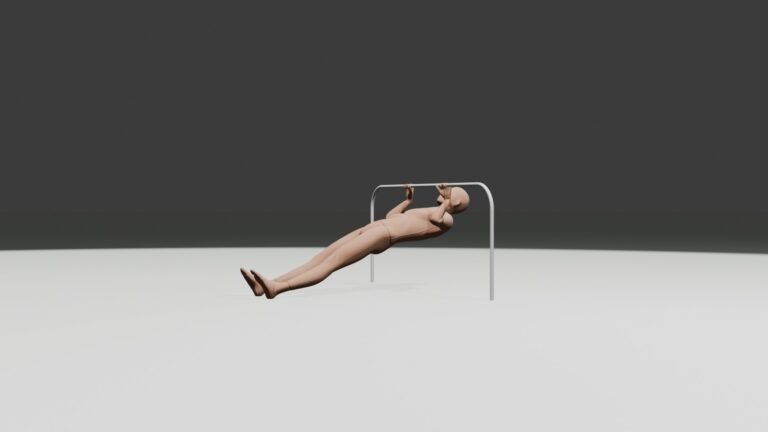
- Inverted Rows (TRX / Suspension Straps / Table): Hang underneath a sturdy table or TRX straps with your heels on the ground. Pull your chest up to the handles. This builds the exact upper-back and grip strength required for vertical pulling.
- Resistance Band Kneeling Lat Pulldowns: Anchor a thick band over a door. Kneel on the floor, grab both ends, and pull your elbows down to your ribs, driving through your lats.
- Doorframe Rows: Stand in a doorway, grab the frame with your fingers, lean back with straight arms, and pull your body forward using your upper back.
Ready to add real home hardware to your space? Read our guide on the Best Home Pull-Up Setup: Doorway Bars vs. Wall Mounts vs. Rings.
Category 2: Cable & Machine Alternatives (Gym)
Commercial gyms offer dedicated machines designed to isolate pulling muscles through structured resistance:
- Lat Pulldowns (Wide / Neutral / Close Grip): The direct mechanical twin to the pull-up. Sitting under a thigh pad allows you to scale resistance precisely to your current strength levels. (See our comparison on Chin-Ups vs. Pull-Ups vs. Neutral Grip to match hand positions on the pulldown handle).
- Assisted Pull-Up Machine: Uses a counterweight platform to offset your body mass. Perfect for practicing the exact motor pattern with reduced resistance.
- Single-Arm High Cable Pulldowns: Sit facing a cable stack, hold a single handle from an elevated pulley, and drive your elbow down into your side to isolate individual lat fibers.
Category 3: Free-Weight Substitutes (Dumbbells & Barbells)
When vertical pulling equipment isn’t available, horizontal free-weight rowing movements hit the lats, rhomboids, and arm flexors effectively:
- Chesterfield / Chest-Supported Dumbbell Rows: Lie face down on an incline bench and pull dumbbells up to your hips. Eliminates momentum and isolates back musculature safely.
- Single-Arm Dumbbell Rows: Support one knee and hand on a bench while rowing a heavy dumbbell upward to build unilateral lat strength.
- Meadows Rows (Landmine): Stand perpendicular to a landmine barbell and row the end of the sleeve up to your waist to target the lower lats and outer back.
Movement Comparison & Conversion Matrix
Use this matrix to swap exercises into your workouts seamlessly:
| Pull-Up Alternative | Target Muscle Focus | Equipment Needed | Skill Level | Similarity to Pull-Up |
| Lat Pulldown | Upper Lats & Teres Major | Cable Machine | Beginner | ★★★★★ (95%) |
| Band Kneeling Pulldown | Lats & Lower Traps | Resistance Band | Beginner | ★★★★☆ (85%) |
| Inverted Bodyweight Row | Rhomboids & Mid-Traps | TRX / Table / Bar | Beginner-Inter. | ★★★★☆ (80%) |
| Chest-Supported Dumbbell Row | Mid-Back & Rear Delts | Dumbbells & Bench | Beginner | ★★★☆☆ (60%) |
| Single-Arm Dumbbell Row | Lats & Core Anti-Rotation | Dumbbell & Bench | Intermediate | ★★★☆☆ (60%) |
How to Program Pull-Up Alternatives
If your goal is to transition from alternative exercises to doing real pull-ups on a bar, follow this 3-day workout swap:
- Exercise 1 (Primary Vertical Pull): Cable Lat Pulldown or Band Kneeling Pulldown — 3 sets x 8–10 reps (Focus on progressive overload).
- Exercise 2 (Horizontal Pull): Inverted TRX Rows or Dumbbell Rows — 3 sets x 10–12 reps (Focus on upper-back volume).
- Exercise 3 (Isometric/Grip Finisher): Heavy Farmers Carries or Banded Holds — 3 sets x 30–45 seconds.
Once you can move 80% of your body weight on the lat pulldown machine, transition to daily mini-sets using The Greasing the Groove Method to lock in your first bodyweight rep.
Frequently Asked Questions (FAQ)
Q: Are lat pulldowns as effective as pull-ups for building back mass?
A: Yes. For raw muscle hypertrophy (growth), lat pulldowns are equally effective because they allow you to isolate the latissimus dorsi without being limited by core fatigue or body weight. However, pull-ups build superior core stability and real-world relative strength.
Q: Can I build a wide back with only dumbbells?
A: Absolutely. Heavy single-arm dumbbell rows, chest-supported dumbbell rows, and dumbbell pullovers hit your lats and rhomboids through a full range of motion, creating back thickness and width without requiring a overhead bar.
Q: What is the best pull-up substitute for beginners who can’t do 1 rep?
A: The two best substitutes are Band-Assisted Pull-Ups and Inverted Rows. Both allow you to work with your body weight in mid-air while scaling down the percentage of total weight you pull.
Q: Can resistance band pulldowns replace real pull-ups long term?
A: Resistance bands are great for high-rep conditioning or home travel workouts. However, because band resistance increases at the top of the stretch rather than maintaining constant tension, they should eventually be paired with free weights or bodyweight bars for optimal strength progression.