
Is creatine good for calisthenics? Yes, creatine can be useful for people who train with their bodyweight, particularly when workouts involve challenging sets of pull-ups, dips, push-ups, and other high-intensity exercises.
Creatine is one of the most extensively researched sports supplements, with strong evidence supporting its benefits for strength training and repeated, short bursts of intense exercise.
However, calisthenics introduces an interesting consideration: your bodyweight is also the resistance you’re lifting.
Creatine can increase water retention and body mass, so athletes working toward skills such as the muscle-up, planche, or front lever may wonder whether the potential strength benefits outweigh the extra weight.
The answer depends on your training goals and how your body responds.
In this guide, we’ll look at what creatine actually does, how it may help with calisthenics, its potential drawbacks, how to use it, and what to look for when buying it.
Quick answer: For generally healthy adults, creatine monohydrate is a well-supported optional supplement for strength training. A common approach is 3–5 grams daily, including rest days. It may support calisthenics performance, but it won’t automatically improve advanced skills, and it isn’t necessary to make progress.
Table of Contents
What Is Creatine and How Does It Work?
Creatine is a naturally occurring compound that your body produces and that you can also obtain through foods such as meat and fish.
Most of the body’s creatine is stored in skeletal muscle.
During intense exercise, your muscles need energy quickly. One important source of this energy is adenosine triphosphate, commonly called ATP.
Your muscles use stored phosphocreatine to help regenerate ATP during short periods of high-intensity activity.
Taking creatine monohydrate increases muscle creatine stores, which can improve performance during certain types of exercise.
This is especially relevant to repeated, challenging sets of resistance training.
According to the Australian Institute of Sport, creatine has strong evidence supporting improvements in high-intensity exercise performance and resistance-training adaptations.
However, creatine doesn’t instantly make you stronger after taking a scoop.
Its benefits develop as muscle creatine stores increase over time.
How Much Creatine Should You Take and When?
For most healthy adults who choose to supplement, 3–5 grams of creatine monohydrate every day is a common, well-researched approach.
You don’t need a complicated schedule.
| Question | Simple answer |
|---|---|
| How much should I take? | 3-5 grams daily |
| Training days? | Yes |
| Rest days? | Yes |
| Before or after training? | Either is fine |
| Do I need a loading phase? | No |
| Do I need to cycle creatine? | No established need |
| How long should I take it? | For as long as you choose to supplement and it remains appropriate for you |
My Recommended Creatine Routine
For simplicity, I would choose 5 grams of plain creatine monohydrate once daily.
Mix it into water, juice, or a protein shake, and take it at whatever time is easiest to remember.
You don’t need to take it immediately before your workout. Consistency matters more than timing.
Continue taking it on rest days if you want to maintain elevated muscle creatine stores.
Do You Need to Load Creatine?
No.
Taking 3–5 grams daily without loading gradually increases muscle creatine stores over approximately four weeks.
A loading phase can increase stores more quickly, but it isn’t necessary for the longer-term benefits.
Do You Have to Take Creatine Forever?
No.
Creatine isn’t something you need to take for the rest of your life.
If you stop supplementing, your elevated muscle creatine stores gradually return toward their previous levels over several weeks.
You may also lose some of the associated water weight, as I noticed during my own break from creatine.
For healthy adults, there is no established requirement to cycle creatine regularly. However, that doesn’t mean lifelong supplementation has been proven safe for every individual.
The simplest approach is to take it consistently while you want its potential benefits, and reassess whether it’s useful for your training.
If you have kidney disease, take medication affecting kidney function, or have another relevant medical condition, seek medical advice before supplementing.
Does Creatine Help With Calisthenics?
Creatine may help with calisthenics for many of the same reasons it helps with traditional resistance training.
Both training styles can involve short, challenging muscular efforts repeated over multiple sets.
However, the evidence is stronger for resistance training in general than for specific advanced calisthenics skills.
| Calisthenics exercise | Potential benefit | Important consideration |
|---|---|---|
| Pull-Ups and Chin-Ups | May support strength development and repeated hard sets | Extra bodyweight can affect repetitions |
| Dips and Push-Ups | May help support high-intensity training | Individual responses vary |
| Muscle-Ups | May support the pulling strength and power developed during training | Technique and coordination remain essential |
| Planche and Front Lever | May indirectly support strength development | Direct evidence for improving hold times is limited |
| High-intensity bodyweight workouts | May improve performance during repeated hard efforts | Less benefit is expected for low-intensity endurance work |
Creatine for Pull-Ups, Chin-Ups, and Dips
Pull-ups, chin-ups, and dips are resistance exercises where your bodyweight provides much of the load.
Research suggests that combining creatine supplementation with resistance training can improve strength over time.
For example, a 2024 systematic review and meta-analysis found greater strength improvements in adults under 50 when creatine was combined with resistance training compared with placebo.
This doesn’t mean taking creatine will automatically add two repetitions to your pull-ups.
However, it may help support the strength development that makes more difficult sets and progressions possible.
If you’re working toward your first pull-up or improving your dips, creatine is an option to consider alongside consistent training, sufficient nutrition, and recovery.
Creatine for Muscle-Ups and Explosive Movements
The muscle-up requires pulling strength, explosive movement, transition technique, and pressing strength.
Creatine has evidence supporting certain measures of strength and power, so it may help with the physical training used to develop these qualities.
For example, explosive high pull-ups and challenging pulling sets are potential areas where creatine-supported training adaptations could be useful.
However, creatine does not teach muscle-up technique.
You still need to develop the pulling path, transition timing, and body control required to get over the bar.
Creatine for Planche and Front Lever
The planche and front lever are advanced static calisthenics skills.
They require significant relative strength, coordination, and the ability to produce force in demanding body positions.
Creatine may help support the strength-training exercises used to develop these skills.
However, there is limited direct research demonstrating that creatine supplementation improves planche or front-lever hold times.
Any improvement would depend on several factors, including training adaptations and changes in bodyweight.
Creatine should be viewed as a possible training aid, not a shortcut to advanced skills.
Does Creatine Water Weight Make Calisthenics Harder?
This is one of the most important questions for calisthenics athletes.
Unlike traditional weightlifting, where resistance can be adjusted by changing the weights, bodyweight exercises often require you to move your own mass.
If your bodyweight increases, exercises such as pull-ups, muscle-ups, and planche progressions may become more demanding.
How Much Weight Can Creatine Add?
Creatine supplementation commonly increases body mass, particularly through increased water retention in the muscles.
The amount varies between individuals.
The Australian Institute of Sport explains that creatine-related increases in bodywater can contribute to weight gain of around 1-2 kg in some individuals.
Not everyone experiences the same change.
Longer-term changes in body composition can also reflect training adaptations, food intake, and other factors.
Is the Extra Water Weight Good or Bad?
It isn’t automatically either.
Increased muscle creatine stores may support strength and performance, while additional body mass increases the load you’re moving during calisthenics.
For example, if you gain some bodyweight without a comparable improvement in pulling strength, your pull-ups might initially feel harder.
On the other hand, if your training performance improves over time, the overall effect may be beneficial.
The important factor is your strength relative to your bodyweight.
My Experience With Creatine and Water Weight
When I started taking creatine, I noticed that my bodyweight increased slightly.
This wasn’t unexpected, since creatine can increase water retention in the muscles.
Later, I went on a vacation for a couple of weeks and stopped taking creatine. After several weeks without supplementing, I noticed that my weight had dropped somewhat.
Some of this change may have been related to the gradual reduction in water weight associated with stopping creatine.
However, I can’t say exactly how much was due to creatine. My eating habits, activity levels, and training also changed during the vacation.
This experience reminded me that bodyweight fluctuations don’t always reflect changes in body fat or muscle mass.
For calisthenics athletes, that’s particularly relevant because even small changes in bodyweight can influence how exercises such as pull-ups and muscle-ups feel.
I wouldn’t judge creatine only by what the scale says. I’d also pay attention to strength, exercise performance, and how training progresses over time.
According to the Australian Institute of Sport, muscle creatine levels and associated bodyweight can gradually return toward their previous levels over approximately 4-6 weeks after stopping supplementation.
How to Tell Whether Creatine Is Helping You
If you decide to try creatine, track a few simple measurements over several weeks:
- Your average morning bodyweight.
- Your clean pull-up repetitions.
- Your performance in challenging pushing and pulling exercises.
- Your ability to maintain good technique during skill progressions.
Try to compare performance under reasonably similar conditions.
If your bodyweight increases, that doesn’t automatically mean creatine is harming your progress.
Look at what happens to your actual training performance.
Remember that improvements or setbacks can have several causes, so you cannot attribute every change to supplementation alone.
How Much Creatine Should You Take for Calisthenics?
For generally healthy adults choosing to use creatine, 3-5 grams of creatine monohydrate daily is a commonly studied approach.
You don’t need a different dosage just because you train calisthenics instead of lifting weights.
Do You Need a Loading Phase?
No. A creatine loading phase is optional.
| Approach | Typical protocol | What to expect |
|---|---|---|
| No loading | 3-5 g daily | Muscle creatine stores increase gradually over approximately 4 weeks |
| Loading | Around 20 g daily, divided into 4 doses, for 5-7 days | Muscle creatine stores increase more quickly |
| Maintenance after loading | Usually 3-5 g daily | Helps maintain elevated muscle creatine stores |
These are common adult protocols described by the Australian Institute of Sport.
Loading isn’t necessary to obtain the longer-term benefits.
It can also increase the likelihood of gastrointestinal discomfort, particularly when large amounts are taken at once.
For someone new to creatine, a simple daily routine without loading is often the most convenient approach.
When Should You Take Creatine?
The most important practical factor is taking it consistently.
You can mix creatine monohydrate with water or take it with a meal.
Research hasn’t established that taking creatine immediately before a workout produces substantially better results than taking it afterward.
Choose a time that helps you remember.
Should You Take Creatine on Rest Days?
Yes, if you’re following a daily supplementation routine.
Creatine works by increasing and maintaining muscle creatine stores rather than functioning like an immediate pre-workout stimulant.
Consistency matters more than whether you’re training that day.
Which Type of Creatine Is Best for Calisthenics?
Creatine monohydrate is the most extensively researched form of creatine.
Other varieties, such as creatine hydrochloride and buffered creatine, are sometimes marketed as more advanced or effective.
However, there isn’t convincing evidence that these alternatives consistently outperform ordinary creatine monohydrate for strength and exercise performance.
For most people, a simple creatine monohydrate powder is a sensible choice.
Does the Creatine Brand Matter?
My approach to buying creatine is simple: I don’t see a reason to pay extra for a premium brand name when a more affordable, reputable product provides the same ingredient.
What matters most is choosing a trustworthy product that contains 100% creatine monohydrate.
A more expensive brand isn’t automatically more effective.
At the same time, price shouldn’t be the only consideration. Accurate labeling, manufacturing quality, and independent testing are also important.
If two reputable products contain the same form of creatine, have comparable quality assurance, and provide the same amount per serving, I would generally choose the cheaper one.
Is Unflavored Creatine Better?
I personally prefer unflavored creatine monohydrate.
It can easily be mixed into water, juice, or a protein shake, and I don’t see much reason to pay extra for flavoring.
Flavored creatine isn’t necessarily bad. If you enjoy the taste and don’t mind paying more, that’s perfectly fine.
However, flavoring doesn’t make the creatine itself more effective.
Some flavored products also contain other ingredients, so it’s worth checking how much actual creatine you receive per serving.
For me, plain, unflavored creatine monohydrate is usually the better-value choice.
Recommended Supplement Setup: Affordable Creatine Monohydrate
When choosing creatine, I recommend keeping things simple.
You don’t need an expensive brand to get the benefits of creatine.
Look for a reputable product containing 100% creatine monohydrate, ideally with independent quality testing.
What I recommend looking for:
- Ingredients: 100% creatine monohydrate, without unnecessary additions.
- Value: Compare the price per 5 g serving, not just the price of the container.
- Quality: Choose a reputable manufacturer, preferably with independent testing.
- Flavor: Unflavored is my preference, especially when it’s cheaper.
- Serving size: Check how many grams of creatine you actually get per serving.
Example Budget Option: Nutricost Creatine Monohydrate
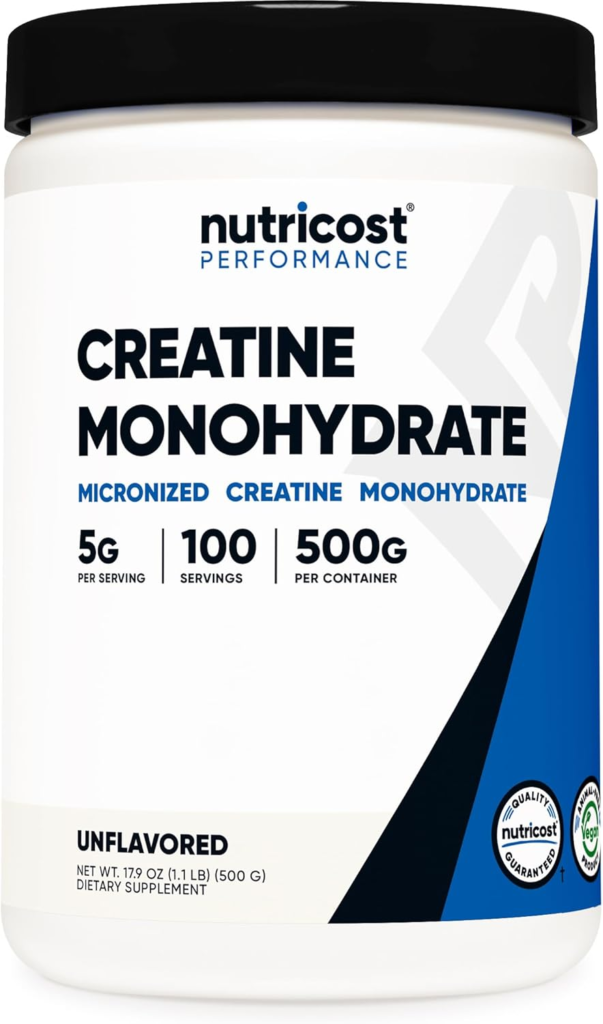
Nutricost Creatine Monohydrate
Nutricost Creatine Monohydrate is an example of the simple, unflavored creatine product I’d consider.
The 500 g container shown provides 100 servings of 5 g each.
It contains the type of creatine I’m looking for without needing an elaborate supplement formula.
However, I wouldn’t recommend buying it just because of the brand name.
Compare its current price per serving with other reputable creatine monohydrate products before purchasing.
Affiliate disclosure: I may earn a commission if you purchase through Amazon link, at no additional cost to you.
My advice: Buy the most affordable reputable, quality-verified creatine monohydrate you can find. The brand name itself isn’t what makes creatine effective.
Creatine is optional, and you can make excellent progress in calisthenics without buying any supplements.
Is Creatine Safe? Side Effects and Precautions
Creatine monohydrate has been extensively studied, including in healthy adults using it alongside resistance training.
Research generally supports its safety at commonly studied doses in healthy adults.
However, that doesn’t mean supplementation is appropriate for everyone or entirely free from possible side effects.
Common Side Effects
Possible effects include:
- Increased bodyweight from water retention.
- Temporary stomach discomfort.
- Bloating or diarrhea, particularly with larger single doses.
Taking smaller amounts instead of a large single dose may improve gastrointestinal tolerance.
Continue following normal hydration practices appropriate for your activity level, climate, and individual needs.
There isn’t good evidence that everyone using creatine must drink a specific additional amount of water every day.
Does Creatine Damage Your Kidneys?
For healthy adults, research generally hasn’t found evidence that commonly studied creatine supplementation protocols cause kidney damage.
However, creatine supplementation can increase blood creatinine levels, which may affect the interpretation of some kidney-function tests.
A 2025 systematic review and meta-analysis found a small increase in serum creatinine but no statistically significant change in glomerular filtration rate in the available studies.
This is reassuring, although the research has limitations and doesn’t prove that supplementation is safe for every individual.
People with kidney disease, abnormal kidney-function results, or other medical conditions affecting kidney health should seek medical guidance before considering creatine.
If you’re taking creatine and undergoing blood tests, tell your healthcare professional so the results can be interpreted appropriately.
Does Creatine Cause Hair Loss?
There is currently no convincing evidence that normal creatine supplementation causes hair loss.
A 2025 randomized controlled trial investigated 5 grams of creatine daily over 12 weeks in resistance-trained men.
The researchers found no significant differences between the creatine and placebo groups in the measured hair-health outcomes.
That is reassuring, but one relatively small, short-term study cannot rule out every possible long-term effect.
Who Should Be Cautious With Creatine?
Talk with a qualified healthcare professional before taking creatine if you have a relevant medical condition, particularly kidney disease, or take medications that may affect kidney function.
People who are pregnant or breastfeeding, and children or teenagers, should obtain individualized professional guidance rather than relying on adult supplementation advice.
Is Creatine Worth Taking for Vegan or Vegetarian Calisthenics Athletes?
Creatine naturally occurs mainly in animal-derived foods such as meat and fish.
People following vegetarian or vegan diets may therefore have lower baseline muscle creatine stores than people who regularly eat meat.
Research suggests that individuals starting with lower muscle creatine stores may experience larger increases in those stores from supplementation.
However, an increase in muscle creatine doesn’t guarantee a larger improvement in every strength or calisthenics performance measure.
Creatine monohydrate is generally manufactured without animal-derived ingredients, but check the complete product formulation if avoiding animal ingredients is important to you.
Is Creatine Worth It for Beginners?
Creatine isn’t required to begin calisthenics.
If you’re learning your first push-up or pull-up, you’ll usually make the most progress by focusing on:
- Consistent workouts.
- Appropriate exercise progressions.
- Sufficient food and protein.
- Sleep and recovery.
- Gradually improving your technique and strength.
Creatine may offer an additional benefit, but it cannot replace those fundamentals.
If you’re completely new to calisthenics, start with the How to Start Bodyweight Training guide or follow the 6-Week Beginner Bodyweight Program.
Frequently Asked Questions
Does Creatine Work for Calisthenics Without Weights?
Yes, it can.
Creatine supports high-intensity muscular performance, and challenging bodyweight exercises are a form of resistance training.
However, results vary, and specific calisthenics skills have not been studied as extensively as conventional resistance exercises.
Can Creatine Increase Pull-Up Repetitions?
Possibly, particularly as part of a longer-term strength-training program.
However, it isn’t guaranteed to add repetitions, and increased bodyweight can affect performance.
Will Creatine Help Me Get My First Muscle-Up?
It may help support strength development, but your muscle-up also depends on explosive pulling, transition mechanics, and pressing strength.
Creatine cannot replace training those skills.
Is Creatine Bad for Planche or Front-Lever Training?
Not necessarily.
The additional bodyweight may matter for skills heavily dependent on relative strength, while improvements in strength training may be useful.
The overall effect depends on the individual, and direct evidence for these specific skills is limited.
How Long Does Creatine Take to Work?
Without loading, muscle creatine stores generally increase over approximately four weeks of regular supplementation.
Loading can increase stores more quickly, but it isn’t required.
Do You Need to Cycle Creatine?
There is no established need for healthy adults to cycle creatine on and off when following an appropriate maintenance protocol.
Does Creatine Work Without Exercising?
Creatine can increase muscle creatine stores without a training program, but the exercise-performance benefits discussed here are most relevant when combined with appropriate training.
Taking creatine doesn’t replace exercise.
Is Creatine a Steroid?
No. Creatine is a naturally occurring compound involved in cellular energy metabolism. It is not an anabolic steroid.
Should I Buy Expensive Creatine?
Not necessarily.
If a cheaper product provides 100% creatine monohydrate with comparable quality assurance, there is generally no evidence-based reason to pay extra for branding alone.
Compare the price per serving and choose a product from a trustworthy manufacturer.
Final Verdict: Should You Take Creatine for Calisthenics?
Creatine monohydrate can be a worthwhile supplement for calisthenics athletes who want to support strength development and performance during demanding workouts.
Its strongest evidence relates to resistance training and repeated high-intensity efforts.
For pull-ups, dips, and explosive pulling exercises, those benefits may be relevant.
However, the potential benefits for advanced static skills such as the planche and front lever are less certain, and increased bodyweight deserves consideration.
From my own experience, creatine was associated with a small increase in bodyweight, followed by some weight loss after I stopped taking it for several weeks.
That experience is consistent with what we know about creatine-related water retention, although I can’t determine exactly how much of my weight change was caused by supplementation.
If you’re a healthy adult considering creatine, a consistent 3–5 gram daily routine is a commonly researched approach.
And when it comes to choosing a product, I wouldn’t overcomplicate things.
Look for plain, 100% creatine monohydrate from a trustworthy manufacturer, compare prices per serving, and avoid paying extra for features you don’t need.
Most importantly, remember that creatine is optional.
Build your strength foundation first, train consistently, and judge the value of supplementation by how your actual performance develops.
References and Further Reading
- Australian Institute of Sport — Creatine — How creatine works, dosing, exercise benefits, water-weight changes, and precautions.
- NIH Office of Dietary Supplements — Exercise and Athletic Performance — Evidence on creatine supplementation, athletic performance, and safety.
- Wang et al. (2024) — Creatine Supplementation and Strength Gains — Systematic review and meta-analysis of creatine combined with resistance training.
- Naeini et al. (2025) — Creatine Supplementation and Kidney Function — Systematic review and meta-analysis examining serum creatinine and kidney function.
- Lak et al. (2025) — Does Creatine Cause Hair Loss? — Randomized controlled trial investigating creatine supplementation and hair-health measurements.
Disclaimer: This article provides general educational information and is not individualized medical or nutritional advice. If you have a medical condition or concerns about supplementation, consult a qualified healthcare professional.